There's a saying in Web3 circles: "If Discord is the town hall, Telegram is the back alley." That alley has become something closer to a digital Grand Bazaar, where communities organize, deals get made, and brands build real loyalty with the people who matter most to them. I think most Western marketing teams still underrate it because they judge it by follower counts, and follower counts are the one number Telegram was never built to inflate.
Telegram marketing is the practice of using channels, groups, and bots to broadcast updates, hold conversations, and convert customers inside the Telegram messaging app. Channels deliver every post to every subscriber with no ranking algorithm in between. Groups give you a two-way community. Bots automate qualification, onboarding, payments, and CRM handoff. Telegram works best as a retention and conversion layer for an audience you already reach elsewhere, and Telegram's recent updates (channel direct messages, suggested posts, public post search, and AI bots that work in any chat) have made it a much stronger one.
This guide covers what Telegram is as a marketing channel, where it outperforms and where it falls short, how bots turn it into a conversion engine, how to build and forecast a Telegram marketing funnel, which tools to use, how to connect it to your CRM, and what changed this year.
What Is Telegram? A Plain-Language Definition for Marketers
Telegram is a cloud-based messaging platform that supports one-to-many broadcast channels, community group chats, and bots capable of automating nearly anything from lead qualification to payment collection. Think of it as the intersection of email, WhatsApp, and Reddit, built on infrastructure designed for privacy and scale. Regular chats are encrypted between your device and Telegram's servers, and users can open optional end-to-end encrypted Secret Chats for one-to-one conversations.
The practical reason marketers care about it is simple: your messages actually get delivered. There's no algorithm deciding whether your channel post is worth surfacing, no throttled reach, and no pay-to-play distribution tax. In a world where organic reach on social platforms has been compressing for years, 100% delivery to every subscriber is a meaningful structural advantage.
The audience is large. Telegram reached 1 billion monthly active users in March 2025, and about 500 million people open it every day. Users open the app about 21 times a day and spend roughly 41 minutes in it, according to figures shared by founder Pavel Durov.
For Web3, AI, and startup brands specifically, Telegram offers something even more valuable. The platform feels personal, the way SMS does, with community infrastructure sophisticated enough to support tens of thousands of members. That combination builds trust faster than most channels can, and trust is ultimately what converts.
Telegram Business: When Chat Becomes CRM
Telegram Business rolled out native CRM-adjacent features including quick replies, welcome message flows, business hours settings, and away messages. In April 2025, Telegram added full automation for business accounts, which lets Premium subscribers connect third-party and AI chatbots that manage messages, profile details, and stories through granular permissions. Telegram's Chat Automation feature extends a version of this to every user: anyone can connect a bot to their profile and choose which chats it answers, such as only new conversations.
For startup marketers, this lowers the setup cost for using Telegram as a structured customer touchpoint. A welcome flow for new contacts, a quick-reply library for common questions, and a bot that triages first messages from strangers handle a significant share of inbound volume before a human ever needs to get involved.
How Telegram Channels and Groups Work for Startup Marketers
Telegram gives you two primary tools, and understanding the difference between them shapes every campaign decision downstream.
Channels are your controlled media outlet. You post, subscribers receive, and there's no back-and-forth noise to manage. They're best suited to full narrative control: product announcements, content drops, exclusive offers for your most engaged audience. The reach is unlimited, the UI is clean, and the subscriber experience is closer to a newsletter than a social feed.
Channels used to be strictly one-directional. Since June 2025, channels can enable direct messages from subscribers, which arrive in a separate admin inbox and keep the owner's personal account private. You can also charge a fee per message to keep the inbox manageable. That turns every channel into a lightweight support and sales desk.
A practical retention tactic that consistently works: mix multimedia into your channel. Voice memos, short videos, and polls break the broadcast monotony and signal to subscribers that there's a human behind the content, which increases retention over time.
Groups are where real community work happens. With up to 200,000 members, pinned messages, admin roles, topics, and moderation tools, a well-run Telegram group is your always-on customer success function, feedback channel, and brand community in one place. Startups use them for AMAs. Fitness brands run accountability challenges inside them. Web3 projects use them to sustain momentum between product launches.
The challenge is moderation. Without clear community norms, a code of conduct pinned at the top, and at least one active moderator checking in daily, open groups drift toward noise quickly. The moderation cost is real and often underestimated, though newer tools like AI guardian bots that screen join requests and native welcome messages visible only to new members reduce it.
The strongest Telegram setups run both in parallel. Use the channel to broadcast, and use the group to respond. That feedback loop sustains engagement without requiring a constant stream of original content from your team, and it creates a natural data source for understanding what your audience actually cares about. Telegram Communities link several channels, groups, and bots under one topic, so members can find and join every chat from a single entry in their chat list.
Where Telegram Outperforms Other Marketing Channels
The simplest way to model Telegram's value is a fraction. The top multiplies the three things a direct channel gives you. The bottom is everything a platform puts between your message and the reader.
Every other major platform increases that denominator. Telegram keeps the noise term at zero for channel posts. Think of the denominator as a toll booth. A 2% organic reach rate on a social feed is the same as a noise value of 49, because 1 divided by 50 is 2%. On Telegram, the booth is gone.
The result is that channels with 10,000 subscribers routinely outperform social accounts with 100,000 followers on measurable engagement. The audience is smaller and more intentional, because people have actively opted into a direct messaging relationship.
Geographic reach is an angle most Western marketers miss entirely. Telegram is a dominant messaging platform across large parts of South and Southeast Asia, Eastern Europe, the Middle East, and Latin America. For startups with global ambitions or Web3 projects targeting developer communities outside North America and Western Europe, this geographic profile is a genuine competitive advantage, particularly when competitors put their community budgets into Discord and X.
In-app payments and commerce represent another underused strength. A well-designed Telegram bot can qualify leads, process payments, gate content by subscription tier, and onboard new community members automatically. That effectively turns the platform into a lightweight CRM with no monthly seat fees. For early-stage teams watching burn, that's a meaningful operational difference.
The intimacy factor also deserves more credit than it typically gets in marketing planning. Telegram sits in the same mental space as SMS for most users: it's where they talk to people they trust. Brands that earn a place in that space, and respect it, build a different quality of relationship than social media produces.
Where Telegram Falls Short
The biggest limitation is discovery. Telegram is a weak place to grow organically from zero. You bring your existing audience to Telegram. This positions the platform as a retention and conversion layer, with acquisition happening on other channels, which has real implications for how you attribute its impact in your marketing mix.
Discovery has improved. Since July 2025, Premium users can search public posts across all channels from a Posts tab, so keyword-rich posts can now surface for people who have never heard of you. Paid placements and suggested posts (covered below) add more on-ramps. They still won't replace the audience you build elsewhere.
If you are building a CMO-level performance dashboard that needs to account for Telegram's contribution to pipeline, frame it this way: Telegram accelerates conversion and reduces churn for audiences you acquired elsewhere. Measuring it as an acquisition channel will undercount its value. Measuring it as an activation and retention channel gives you a more accurate picture.
Native analytics are limited, too. Channel statistics cover views, subscriber growth, and engagement, and polls now show vote statistics over time once they pass 100 votes. Attribution is still shallow compared to Meta or Google. You will need UTM parameters on every outbound link and an external analytics layer to connect Telegram activity to downstream pipeline events.
Open groups without proper onboarding flows also attract spam quickly. The platform's openness is its strength and its vulnerability in equal measure. The teams that manage this best treat their onboarding flow as a first-impression conversion moment.
Telegram Bots: Automation and Lead Qualification at Scale
This is where Telegram separates itself from every other community platform. The bot ecosystem is mature, well documented, and powerful enough to automate workflows that would carry real cost in other tools.
Starting with @BotFather, Telegram's native bot management tool (now also a mini app), you can build custom bots that handle FAQ responses at scale, qualify leads through decision-tree flows, run personalized onboarding sequences for new members, deliver gated content based on subscription status, and accept payments natively inside the app. The Telegram Bot API is open, actively maintained, and supported by an active developer community.
For teams that don't want to write code, tools like ManyChat and SendPulse let marketers build flows through visual interfaces. ManyChat works in private chats with your bot, while SendPulse also supports groups and channels. If you already run automations, n8n has native Telegram trigger and action nodes that can pass bot events straight into HubSpot, Salesforce, Pipedrive, or a spreadsheet without manual data entry.
If you are already thinking about how agentic AI fits into your marketing stack, Telegram bots are now one of the most accessible entry points. Recent updates moved bots much closer to AI agents:
- Guest bots: Users can tag a bot by @username in any chat, even one it hasn't joined, and it replies in place. The bot only sees the message it was tagged in.
- Bot-to-bot communication: Bots can now respond to other bots, which makes multi-agent workflows possible inside Telegram.
- Streaming and rich text: Bots can stream replies as they generate and send rich formatted messages up to 32,768 characters, with tables, collapsible sections, and inline media.
- Ephemeral messages and in-message buttons: Bots in groups can send replies only one person can see, and developers can place buttons inside the text of a message to run surveys, quizzes, or product flows without cluttering the chat.
- Managed bots: bots can create and manage other bots, which lowers the setup cost for agencies running many client bots.
The caveat is that bots require real thought to deploy well. Users recognize a clunky or inauthentic bot experience quickly, and a bad one erodes the trust the channel worked to build. The best bots are invisible in the sense that users simply feel well served.
A few practical capabilities worth knowing before you start building:
- Lead qualification: Decision-tree flows that ask progressive questions and segment users by intent before routing to a human or a CRM record. If your scoring logic needs a rethink first, my post on broken lead scoring models covers the common failure modes.
- Onboarding sequences: Automated welcome flows triggered by new member joins, with timed follow-ups that introduce your community norms and key content.
- Gated content delivery: Subscription or payment verification before delivering a file, link, or course module.
- Support deflection: FAQ automation that resolves common questions instantly, reducing repeated inquiries in your group.
- Event-triggered messages: Behavior-based messaging that fires when a user clicks a link, completes a form, or reaches a milestone in your onboarding flow.
How Do You Build a Telegram Marketing Funnel?
You build a Telegram marketing funnel by mapping channels, groups, and bots to the stages your CRM already tracks. The first time someone asks you for a "conversion-optimized funnel" on Telegram, the brief feels strange. No subject lines. No tracking pixel on the post. No retargeting audience. If you came up through CRMs, nurture streams, and MQL (marketing qualified lead) scoring, it feels like running marketing operations with oven mitts on. The three primitives fix that, because each one maps cleanly to a job your existing stack already does.
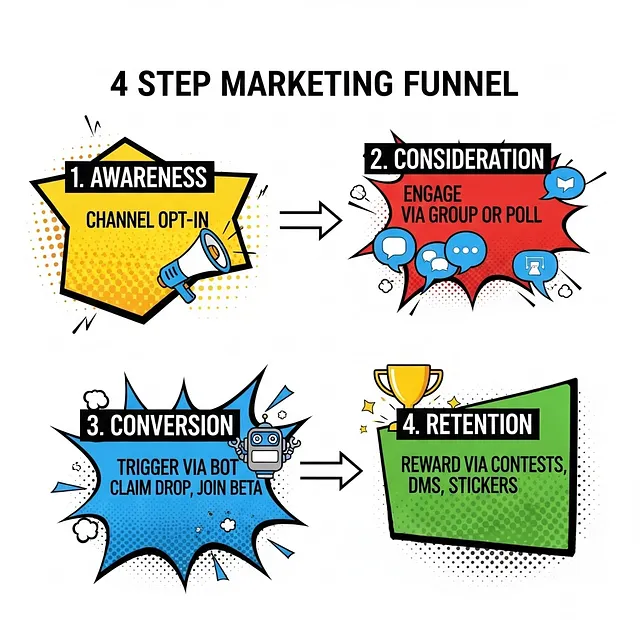
Put them together and you get a CRM funnel rebuilt for messaging:
- Awareness happens when someone opts into the channel.
- Consideration deepens when they answer a poll, send the channel a direct message, or join the group.
- Conversion fires through the bot, which can gate a beta, claim a drop, or book a call.
- Retention comes from rewards the bot tracks: contests, contributor shout-outs, early access.
The channel anchors the system because Telegram applies no ranking algorithm to it. Every post lands in every subscriber's feed in chronological order. Compare that to Meta, where organic posts reach roughly 1 to 3% of followers before the algorithm decides who else sees them. On Telegram, your reach is a function of what you publish.
Telegram Engagement Math: View Rate and Funnel Conversion
A channel with 10,000 subscribers means 10,000 people could read your post. The number who actually do is your view rate, and for healthy channels that figure sits between 15% and 30%.
To forecast outcomes, model the funnel as a chain of doorways. Each doorway only lets a fraction through, so the size of the final room is the product of how wide every doorway is:
Run a realistic channel through it:
Eight qualified actions from one post feels small until you remember two things. First, you can publish daily without algorithmic penalty, so the system compounds. Second, the equation tells you which doorway to widen. A better hook lifts the view rate. A sharper call to action lifts clicks. A smoother bot flow lifts conversion. You stop guessing and start tuning one variable at a time. I go deeper on this multiplication logic in the math behind your marketing funnel.
For context on the channel itself, Telegram audiences generate more than 1 trillion channel views every month, and the platform skews toward buyers in their prime: 53.5% of users are aged 18 to 34.
How does that view rate stack up against the channel it most resembles?
Every other major platform increases that denominator. Telegram keeps the noise term at zero for channel posts. Think of the denominator as a toll booth. A 2% organic reach rate on a social feed is the same as a noise value of 49, because 1 divided by 50 is 2%. On Telegram, the booth is gone.
The result is that channels with 10,000 subscribers routinely outperform social accounts with 100,000 followers on measurable engagement. The audience is smaller and more intentional, because people have actively opted into a direct messaging relationship.
Geographic reach is an angle most Western marketers miss entirely. Telegram is a dominant messaging platform across large parts of South and Southeast Asia, Eastern Europe, the Middle East, and Latin America. For startups with global ambitions or Web3 projects targeting developer communities outside North America and Western Europe, this geographic profile is a genuine competitive advantage, particularly when competitors put their community budgets into Discord and X.
In-app payments and commerce represent another underused strength. A well-designed Telegram bot can qualify leads, process payments, gate content by subscription tier, and onboard new community members automatically. That effectively turns the platform into a lightweight CRM with no monthly seat fees. For early-stage teams watching burn, that's a meaningful operational difference.
The intimacy factor also deserves more credit than it typically gets in marketing planning. Telegram sits in the same mental space as SMS for most users: it's where they talk to people they trust. Brands that earn a place in that space, and respect it, build a different quality of relationship than social media produces.
Where Telegram Falls Short
The biggest limitation is discovery. Telegram is a weak place to grow organically from zero. You bring your existing audience to Telegram. This positions the platform as a retention and conversion layer, with acquisition happening on other channels, which has real implications for how you attribute its impact in your marketing mix.
Discovery has improved. Since July 2025, Premium users can search public posts across all channels from a Posts tab, so keyword-rich posts can now surface for people who have never heard of you. Paid placements and suggested posts (covered below) add more on-ramps. They still won't replace the audience you build elsewhere.
If you are building a CMO-level performance dashboard that needs to account for Telegram's contribution to pipeline, frame it this way: Telegram accelerates conversion and reduces churn for audiences you acquired elsewhere. Measuring it as an acquisition channel will undercount its value. Measuring it as an activation and retention channel gives you a more accurate picture.
Native analytics are limited, too. Channel statistics cover views, subscriber growth, and engagement, and polls now show vote statistics over time once they pass 100 votes. Attribution is still shallow compared to Meta or Google. You will need UTM parameters on every outbound link and an external analytics layer to connect Telegram activity to downstream pipeline events.
Open groups without proper onboarding flows also attract spam quickly. The platform's openness is its strength and its vulnerability in equal measure. The teams that manage this best treat their onboarding flow as a first-impression conversion moment.
Telegram Bots: Automation and Lead Qualification at Scale
This is where Telegram separates itself from every other community platform. The bot ecosystem is mature, well documented, and powerful enough to automate workflows that would carry real cost in other tools.
Starting with @BotFather, Telegram's native bot management tool (now also a mini app), you can build custom bots that handle FAQ responses at scale, qualify leads through decision-tree flows, run personalized onboarding sequences for new members, deliver gated content based on subscription status, and accept payments natively inside the app. The Telegram Bot API is open, actively maintained, and supported by an active developer community.
For teams that don't want to write code, tools like ManyChat and SendPulse let marketers build flows through visual interfaces. ManyChat works in private chats with your bot, while SendPulse also supports groups and channels. If you already run automations, n8n has native Telegram trigger and action nodes that can pass bot events straight into HubSpot, Salesforce, Pipedrive, or a spreadsheet without manual data entry.
If you are already thinking about how agentic AI fits into your marketing stack, Telegram bots are now one of the most accessible entry points. Recent updates moved bots much closer to AI agents:
- Guest bots: Users can tag a bot by @username in any chat, even one it hasn't joined, and it replies in place. The bot only sees the message it was tagged in.
- Bot-to-bot communication: Bots can now respond to other bots, which makes multi-agent workflows possible inside Telegram.
- Streaming and rich text: Bots can stream replies as they generate and send rich formatted messages up to 32,768 characters, with tables, collapsible sections, and inline media.
- Ephemeral messages and in-message buttons: Bots in groups can send replies only one person can see, and developers can place buttons inside the text of a message to run surveys, quizzes, or product flows without cluttering the chat.
- Managed bots: bots can create and manage other bots, which lowers the setup cost for agencies running many client bots.
The caveat is that bots require real thought to deploy well. Users recognize a clunky or inauthentic bot experience quickly, and a bad one erodes the trust the channel worked to build. The best bots are invisible in the sense that users simply feel well served.
A few practical capabilities worth knowing before you start building:
- Lead qualification: Decision-tree flows that ask progressive questions and segment users by intent before routing to a human or a CRM record. If your scoring logic needs a rethink first, my post on broken lead scoring models covers the common failure modes.
- Onboarding sequences: Automated welcome flows triggered by new member joins, with timed follow-ups that introduce your community norms and key content.
- Gated content delivery: Subscription or payment verification before delivering a file, link, or course module.
- Support deflection: FAQ automation that resolves common questions instantly, reducing repeated inquiries in your group.
- Event-triggered messages: Behavior-based messaging that fires when a user clicks a link, completes a form, or reaches a milestone in your onboarding flow.
How Do You Build a Telegram Marketing Funnel?
You build a Telegram marketing funnel by mapping channels, groups, and bots to the stages your CRM already tracks. The first time someone asks you for a "conversion-optimized funnel" on Telegram, the brief feels strange. No subject lines. No tracking pixel on the post. No retargeting audience. If you came up through CRMs, nurture streams, and MQL (marketing qualified lead) scoring, it feels like running marketing operations with oven mitts on. The three primitives fix that, because each one maps cleanly to a job your existing stack already does.
Eight qualified actions from one post feels small until you remember two things. First, you can publish daily without algorithmic penalty, so the system compounds. Second, the equation tells you which doorway to widen. A better hook lifts the view rate. A sharper call to action lifts clicks. A smoother bot flow lifts conversion. You stop guessing and start tuning one variable at a time. I go deeper on this multiplication logic in the math behind your marketing funnel.
For context on the channel itself, Telegram audiences generate more than 1 trillion channel views every month, and the platform skews toward buyers in their prime: 53.5% of users are aged 18 to 34.
How does that view rate stack up against the channel it most resembles?
The headline numbers land close together. The real edge shows up in the bottom three rows. Telegram delivers to everyone, instantly, and invites a reply.
What Telegram Content Earns the Open?
Telegram content earns the open when it reads like a message from a sharp colleague. Telegram lives in the same pocket as messages from someone's family, and that intimacy raises the bar on tone. Broadcast copy reads as noise here.
A few formats consistently earn the open:
- First-to-know drops with a real time limit, so the channel becomes the fastest way to hear good news.
- Weekly voice memos from the founder, which carry warmth that text cannot fake.
- Quizzes that reflect something back to the reader ("Which builder archetype are you?").
- Roadmap polls that hand real influence to the community, then visibly act on the result. Channel admins can now restrict polls to subscribers or specific countries, which keeps outsiders from skewing the vote.
- Long-form posts. Premium users can publish rich text posts with headings, tables, and inline media up to 32,768 characters, so a full product update or mini case study can live natively in the channel.
- Live Stories. Since November 2025, you can stream with a live chat inside a Telegram Story, a lighter alternative to a full AMA.
One recent change affects how you write. Telegram now generates AI summaries of long channel posts, so many readers see the gist before they read the full text. Put your main point and your call to action in the first two lines.
Roadmap polls matter more than they look. When you ship the feature the channel voted for, you convert an audience into co-authors. Three motivations stack to drive that action: curiosity about the result, the exclusivity of getting to decide, and the ease of a single tap. Lower the effort and raise the payoff, and participation follows.
How Do You Build and Manage an Active Telegram Community?
You build an active Telegram community by designing loops, where one good interaction becomes the reason for the next one. Design three of them.
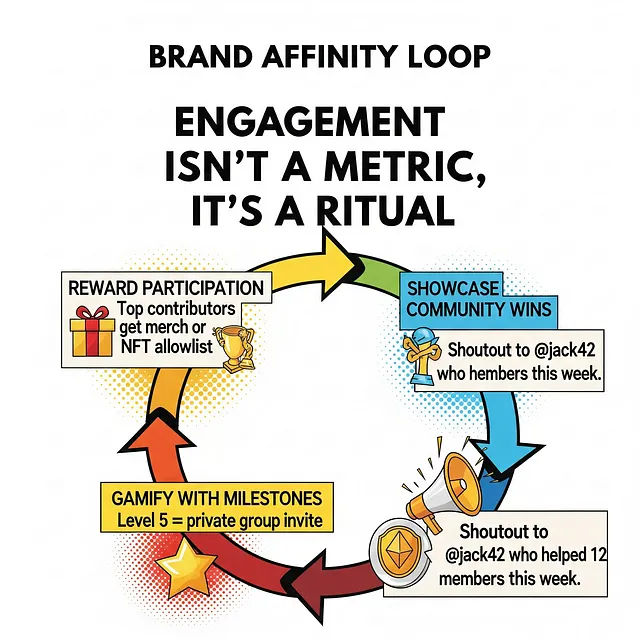
Reward participation. Give the top five contributors each month something they would actually want: merch, an allowlist spot, a private call. Recognition is the cheapest retention lever you have. Member tags give you a visible way to do it, since admins can assign labels like "Top Contributor" next to a member's name.
Gamify the path. Tie milestones to access. Reach level five and the private group opens. Progress the member can see keeps them moving.
Showcase the wins. Publicly thank the person who helped twelve others this week. Members who feel seen become members who stay, and they pull others in behind them.
The aim across all three is ownership. A member who shapes the roadmap, earns recognition, and gets celebrated starts treating the community as partly theirs. That sense of stake separates a lively channel from a dead one.
Telegram community management guidelines
- Write rules and pin them. Put the code of conduct in the native welcome message so every new member sees it once, privately.
- Gate the door. Turn on join requests and let an AI guardian bot screen applicants with a short question or quiz before they can post.
- Use topics. Split large groups into topics (support, announcements, off-topic) so new members find answers without asking.
- Staff it daily. Name at least one human moderator per time zone you serve, and give them the new tools to remove reactions from specific users during spam raids.
- Disclose incentives. Label airdrops, affiliate links, and paid placements plainly. If you run token incentives, my guide on crypto airdrop strategy covers how to avoid attracting farmers.
Which New Telegram Features Should Marketers Use?
Telegram ships a major update roughly once a month, and several recent ones change how marketers should use the platform. Here are the ones I'd act on, in order of impact for a startup team.
The pattern across these updates is clear. Telegram is closing its two biggest gaps for marketers: discovery and two-way contact with channel audiences. The core advice holds. The execution got easier.
What Are the Best Telegram Marketing Tools for Businesses?
The best Telegram marketing tool is usually a native feature first and a third-party tool second. Telegram has absorbed many jobs that used to require a bot, so check what's built in before you add a subscription. My rule: pick tools by the job, and treat tool selection as a downstream decision of your funnel design.
If you already run n8n, start there. A Telegram trigger, a HubSpot node, and a Slack alert cover most of what a startup needs in an afternoon. I compare n8n with newer agent builders in Google Antigravity vs. n8n.
How Do You Connect Telegram to Your CRM and Sales Pipeline?
You connect Telegram to a CRM by sending bot events to it through a webhook, keyed on the user's Telegram ID. Every time a user taps "Join Beta", books a call, or finishes a qualification flow, the bot fires an event. An automation tool catches it and creates or updates the contact, deal, and segment. The Bot API is built for exactly this kind of handoff, and there are more than 10 million bots in the ecosystem to learn from.
Two details save a lot of cleanup later. Store the Telegram user ID as a custom property and deduplicate on it, since many Telegram users never share an email address. And use Log In With Telegram on your site, which lets a user sign up with their Telegram account and optionally share a phone number, so you can match web and Telegram activity to one contact.
For sales teams, the same pattern works with Pipedrive or Salesforce. The CRM changes. The event design stays the same.
How Do You Grow a Telegram Channel With Paid Placements?
You grow a Telegram channel with paid placements through Telegram Ads, suggested posts in partner channels, and cross-promotion. All three work best once your channel already has content worth subscribing to, because paid traffic lands on your last ten posts.
- Telegram Ads. The official self-serve platform at ads.telegram.org places short sponsored messages in large public channels, targeted by channel and topic. The Pixel Tag lets advertisers in supported countries track website conversions from those ads.
- Suggested posts. Since July 2025, you can offer Stars or Toncoin to a channel owner to publish your post. The owner can request edits, and the payment releases 24 hours after posting, or returns to you if the post comes down early. A profile rating based on past Star transactions helps channel owners trust you.
- Cross-promotion. Swap shout-outs with complementary channels of similar size. It's still the cheapest early growth lever.
The free on-ramps still matter most. Announce the channel across email, LinkedIn, X, and your site, and embed a join link in your product and post-purchase flows. The same compounding logic I describe in my Reddit marketing guide applies here: show up with useful content before you ask for anything.
Scaling Telegram Marketing Operations: Integrations and KPIs
You have a channel publishing, a group buzzing, and a bot converting. Now make it run without your hands on every lever.
Integration stack
- CRM sync. Pipe bot events into HubSpot, Salesforce, or Pipedrive as described above.
- Analytics. Telegram posts carry no click attribution on their own, so tag every outbound link with UTMs and read the rest in Google Analytics. Add the Telegram Ads Pixel Tag if you run official ads.
- Scheduling. Use native scheduled messages, including silent delivery and repeating schedules, so your cadence holds when you're heads-down.
- Mini Apps. For deeper journeys, build the experience inside Telegram itself. More than 500 million people use Telegram Mini Apps, and their ad placements report click-through rates of 20 to 40%, well above standard mobile formats. A catalog, a booking flow, or an onboarding wizard can all live in-chat.
KPI dashboard
Telegram ships no unified marketing dashboard, so build a lightweight one and review it weekly:
View rate doubles as your authenticity check. A channel with 10,000 subscribers and 200 views per post signals bought followers to anyone evaluating it, so protect the ratio and grow it honestly.
Telegram Moderation and Brand Safety
Telegram's privacy-first design attracted people who wanted to operate in the dark, and for years the platform kept a famously light touch. That changed after founder Pavel Durov was arrested in France in August 2024 over insufficient moderation. The company updated its policy to hand phone numbers and IP addresses to law enforcement under a valid court order, opened reporting on private and group chats, and leaned on AI moderation. It removed 15.4 million groups and channels in 2024, blocked more than 43 million across 2025, and its safety page keeps a running count for the current year.
For a brand, the platform is cleaner than its reputation suggests, and the housekeeping is still yours to do. Three habits keep you safe:
- Moderate on purpose. Write community rules, pin them, and enforce them consistently.
- Invite real voices. A room of cheerleaders flatters you and teaches you nothing, so make space for honest pushback.
- Disclose incentives. Label airdrops, affiliate links, suggested posts you paid for, and other paid placements plainly. Trust is the whole asset here.
Why Telegram Belongs in Your Channel Strategy
Think of your stack as a building. Email is the invitation that gets people in the door. X is the megaphone on the front lawn. Telegram is the living room, where people settle in, talk back, and decide whether they want to stay. That room rewards presence over volume.
If you're thinking about how Telegram fits into a broader GEO-optimized content strategy, it amplifies content you already produce elsewhere and works best on top of your owned media. Start where the conversation already happens. The audience is there, the reach is unthrottled, and the relationship compounds every time you show up with something worth opening.
If this connects to something you're trying to solve, book a complimentary consulting session. No pitch, just perspective.
Frequently Asked Questions About Telegram Marketing
Is Telegram good for marketing?
Yes. Telegram reaches more than 1 billion monthly active users, applies no ranking algorithm to channel posts, and supports two-way conversation through groups, channel direct messages, and bots. That combination makes it strong for community building, product launches, and direct customer engagement, especially in crypto, fintech, AI, and SaaS.
How is Telegram different from Discord for marketing?
Discord is built around real-time voice and text communities with channel hierarchies and role-based access. Telegram is built around messaging, which gives it stronger reach mechanics (channels work like a newsletter with 100% delivery), better bot infrastructure for automation, and a more global user base. Discord tends to suit gaming, developer tooling, and voice-heavy communities. Telegram tends to suit Web3 projects, direct-to-audience content distribution, and automated lead nurturing at scale.
Can Telegram replace email marketing for a startup?
Telegram works best alongside email. It beats email on delivery and immediacy: email open rates average around 20 to 25% and pass through spam filters and inbox tabs, while Telegram delivers every channel post to every subscriber instantly. Email still wins on segmentation depth, CRM integration maturity, and regulatory familiarity (CAN-SPAM, GDPR). The strongest setups use both: Telegram for time-sensitive updates and community, email for structured nurture and lifecycle campaigns.
Should I use a Telegram channel or a group?
Use both. A channel broadcasts one-to-many for announcements and drops, working like a newsletter. A group runs many-to-many for AMAs, polls, and feedback, working like a town square. Pair them with a bot that automates welcomes, drip sequences, and conversions, and link them together with Telegram Communities.
What is a good view rate for a Telegram channel?
A healthy channel sees 15% to 30% of its subscribers view each post. A channel of 10,000 subscribers should pull 1,500 to 3,000 views per post. A view-to-subscriber ratio well below that range usually signals bought or inactive followers.
What can Telegram bots actually do for a marketing team?
A Telegram bot can qualify leads through conversational decision trees, automate onboarding for new members, deliver gated content after payment or subscription verification, deflect common support questions, and pass structured data to a CRM like HubSpot, Salesforce, or Pipedrive. Bots can now also be tagged in any chat, talk to other bots, stream AI responses, and screen group join requests.
What are the best Telegram marketing tools for businesses?
Start with native features: welcome messages, scheduled posts, channel direct messages, AI guardian bots, and channel statistics. Add ManyChat or SendPulse for visual bot flows, Combot for group moderation, InviteMember for paid memberships, TGStat for channel benchmarking, and n8n, Zapier, or Make to sync bot events with your CRM.
How do you connect Telegram to a CRM?
Send bot events to an automation tool such as n8n through a webhook, then create or update the contact and deal in your CRM. Store the Telegram user ID as a custom property and deduplicate on it, since many users never share an email. Log In With Telegram on your website helps match web visitors to their Telegram identity.
How do you grow a Telegram channel from scratch?
Growth starts with your existing audience and distribution. Announce the channel across email, LinkedIn, X, and your website, give a clear reason to join, and deliver value immediately through a welcome message or bot. Then add cross-promotion with complementary channels, suggested posts in partner channels, and Telegram Ads. Keyword-rich posts can also surface in Telegram's public post search.
What analytics does Telegram provide natively?
Telegram's native analytics cover channel views, subscriber growth and churn, post reach, engagement, and poll statistics over time. It does not provide link click attribution or downstream pipeline reporting for organic posts. Use UTM parameters on every outbound link, an analytics integration that connects Telegram traffic to your CRM, and the Telegram Ads Pixel Tag for paid campaigns.
Is Telegram safe for brands?
It is safer than its early reputation suggests. After founder Pavel Durov's 2024 arrest in France, Telegram began cooperating with law enforcement under court orders, expanded AI moderation, and blocked more than 43 million channels and groups in 2025. Brands still need to moderate their own communities, write clear rules, and disclose incentives.