Gartner is telling marketing leaders two things about AI agents that sound like they can't both be true. It expects 40% of enterprise apps to include task-specific AI agents by the end of 2026, up from under 5% a year earlier. It also predicts over 40% of agentic AI projects will be canceled by 2027. I think both forecasts are right, and the gap between them is where the next good marketing team gets built.
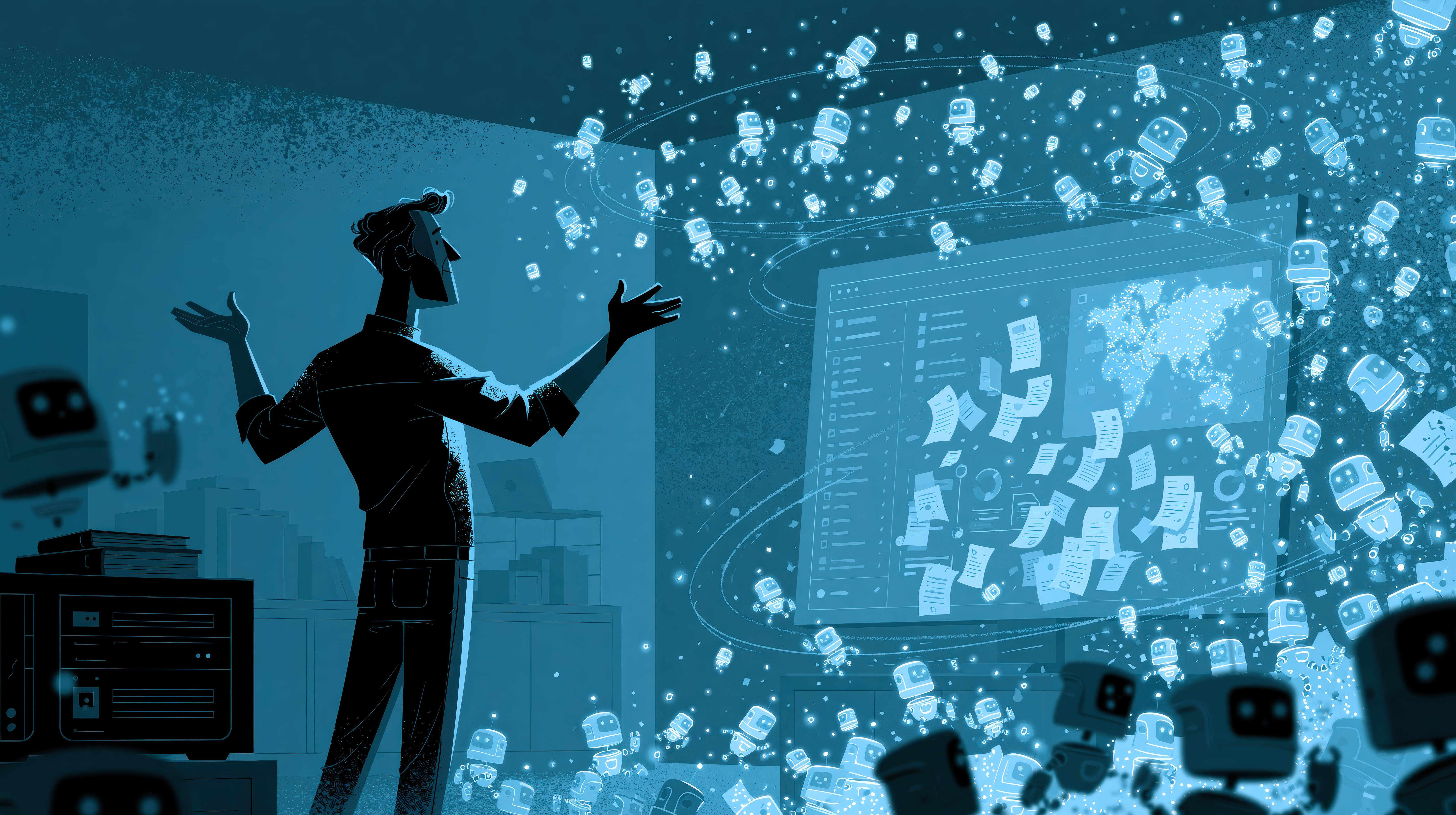
AI agents are going to absorb a large share of marketing execution and very little of the judgment. An AI agent swarm, also called a multi-agent system, is a group of specialized agents run by a lead orchestrator agent, where each agent owns a single job like research or drafting. The teams pulling ahead in 2026 are small groups of people who design these swarms, supervise them, and edit what comes out. The human work moves up a level, and that's the part I find most interesting.
What is the current state of AI agents in marketing?
Adoption is lopsided. McKinsey's 2026 State of AI survey found that 40% of companies with more than $1 billion in revenue are now scaling AI agents, up from 27% the year before, while smaller organizations stayed flat at 22%. That gap surprised me, because agents should matter more to a lean team than to a big one.
Marketing leaders are already feeling it in their org charts. Gartner reports that 62% of CMOs say AI-driven automation has forced them to rethink essential roles. The results haven't caught up with the ambition yet. MIT's NANDA initiative found that 95% of corporate generative AI pilots delivered no measurable return, and Gartner thinks only about 130 of the thousands of vendors calling themselves "agentic" offer real agentic capability. The rest are relabeled chatbots.
My read is that most of these failures trace back to one mistake: teams bought agents before they'd written down how the work actually gets done.
Why do AI agents matter more than the marketing automation you already use?
A chatbot sits there until you type the next prompt. An agent receives a goal, picks its own tools, checks its work, and keeps going until the job is done. Think of the gap between a calculator and an intern who has a calculator, a login to your CRM (customer relationship management system), and a to-do list.
For anyone building a marketing function, that changes the math. Execution hours used to cap what a small team could ship. A bootstrapped founder with three well-built agents can now cover competitive research, first-draft content, and lead enrichment, work that used to take several hires. A marketing operations (MOPS) leader can turn a runbook into a running system, and an engineer can treat the funnel like any other pipeline with inputs, outputs, and tests.
What are AI agent swarms, and how do they work?
Gartner put multiagent systems on its list of top strategic technology trends for 2026, defining them as "collections of AI agents that interact to achieve individual or shared complex goals." The most common setup works a lot like a newsroom, where an editor hands out stories, reporters work them in parallel, and a fact-checker reads everything before it runs.
The best public evidence for this design comes from Anthropic. Its multi-agent research system uses one lead agent to direct parallel subagents, and it outperformed a single agent by 90.2% on Anthropic's internal research tasks. OpenAI's experimental Swarm framework popularized a related idea called the "handoff," where one agent passes the conversation to a specialist better suited to the next step. OpenAI has since folded Swarm into its production Agents SDK, which now competes with several other agent platforms.
All that parallel work costs money, and you can measure how much. Anthropic reports that a single agent uses about 4 times the tokens of a normal chat, and a multi-agent system uses about 15 times. That gives you a simple test:
The finished task has to be worth more than fifteen times what a normal chat would cost. If a chat answer costs a dime, a swarm run costs about $1.50. I'd happily pay that for a full competitor teardown, and I'd never pay it for an email subject line. Anthropic also points out that swarms struggle when every agent needs the same context, so I keep brand voice decisions with a single agent and a human editor.
How do you build an AI agent team for marketing?
Anthropic's guidance on building effective agents is to start with the simplest thing that works, and I build in that order.
- Pick one recurring workflow with a clear finish line. A weekly competitor brief is a good start.
- Build one agent first. I use the AI Agent node in n8n (n8n vs. Google Antigravity) and connect tools through the Model Context Protocol (MCP), an open standard that lets agents read from your CRM, analytics, and docs.
- Write the job description. Spell out the instructions, the tools it can use, its guardrails, and the exact output format you want back. Write it like an onboarding doc for a new hire.
- Add a reviewer agent once quality plateaus. Add an orchestrator once you have three or more specialists.
- Put a human approval gate before anything goes public. The same goes for anything that spends budget or touches customer data.
- Track cost per run, error rate, and hours returned. If those numbers fail the equation above, shut the swarm down.
This is the content swarm I'd hand a lean team on day one:
Every row has a person attached, because those checkpoints are where accountability lives. They're also what keeps AI slop off your site.
What does an AI-native marketing team look like?
Gartner predicts that within three years, half of CMOs will move to a fully composable marketing organization, where AI-dependent teams pull from a shared pool of resources. In practice, I expect that to look like pods of two to four people, each owning a revenue outcome and a fleet of agents.
Gartner also expects that by 2029, at least half of knowledge workers will learn to work with, govern, or create AI agents. My bet is that marketers who can write a solid agent spec will outpace the ones waiting for a vendor to package one.
Which marketing roles will AI agents replace, and which will grow?
The shrinking roles worry me because of what they used to teach. Those jobs are where most of today's CMOs learned the craft. If agents absorb the entry-level work, leaders will need a new kind of apprenticeship, one where juniors learn by supervising agents and editing their output.
The data gives teams some room to get this right. McKinsey found that 39% of respondents expect AI-driven headcount cuts in the coming year, while only 14% actually saw cuts last year. That lag gives every team a window to retrain people before it restructures.
What should marketing leaders do next?
Marketers supervising several AI systems at once used to sound like a forecast. Today it's how the fastest teams already work. If you're starting from zero, pick one workflow, build one agent, and put one person in charge of checking its output. Expand when the numbers tell you to.
An agent can draft a thousand emails before lunch, but someone still has to decide which of them should never go out.
If this connects to something you're trying to solve, book a complimentary consulting session. No pitch, just perspective.
Frequently asked questions about AI agents in marketing
Will AI agents replace marketing jobs?AI agents will replace many marketing tasks, especially research, first drafts, and reporting. Roles built on judgment, brand ownership, relationships, and systems design are growing.
What is the difference between an AI agent and an agent swarm?A single AI agent pursues one goal with its own tools. A swarm, or multi-agent system, coordinates several specialized agents under an orchestrator so work can run in parallel.
How do I build my first AI marketing agent?Pick one recurring workflow with a clear finish line, build a single agent in a tool like n8n, and add a human approval step before anything goes public.
How much does an AI agent swarm cost to run?Anthropic measured multi-agent systems at roughly 15 times the token usage of a standard chat. A swarm makes sense when the finished task is worth more than that multiple.
Do on-chain AI agents change how marketing teams use agents?On-chain AI agents record their identity and activity on a blockchain, which makes their actions auditable and lets them hold or move tokens. Draft standards like ERC-8004 (Trustless Agents) aim to let agents from different companies find and verify each other, and zero-knowledge proofs let them prove their work privately. The same rules apply on-chain or off: start small and keep a human approval gate.