AI agents that negotiate, trade, and transact without supervision run into a structural problem before they run into a technical one: they need to prove their trustworthiness without exposing the data or logic that makes them valuable in the first place. Zero-knowledge proofs resolve that tension, and zero-knowledge virtual machines (ZKVMs) extend the same idea from one-time proofs into programmable, ongoing agent-to-agent logic. What follows covers what these technologies actually do, where they already run in production, how to message them to different audiences, and what to act on this quarter.
Every founder I talk to who's deploying autonomous AI agents eventually runs into the same paradox. An agent that negotiates a contract, prices a trade, or approves a transaction on its own only earns trust if someone can verify what it did, yet the moment you expose that verification, you've also handed over the proprietary logic or data that made the agent worth building in the first place. That tension, between proving something is true and protecting what makes it valuable, sits underneath nearly every serious conversation about autonomous commerce right now, and it's quietly reshaping how we think about verification, privacy, and trust in an economy increasingly run by software no one is watching in real time.
Why AI Agents Have a Trust Problem
Picture a company that deploys AI agents to handle supplier negotiations, data partnerships, and customer service. Each of these agents needs to do something that sounds almost contradictory. It needs to prove it has access to valuable data without revealing that data. It needs to demonstrate it processed information correctly without exposing the algorithm that did the processing. It needs to verify compliance with regulations without opening its internal logic to an auditor. And it needs to build a reputation through a verifiable track record, the same way a contractor earns trust through completed jobs rather than promises.
Traditional approaches force an uncomfortable choice here. A company can reveal its methods and lose its competitive edge, or it can trust blindly and risk fraud. Zero-knowledge cryptography offers a way out of that choice. It provides cryptographic certainty without requiring exposure of the data or logic underneath it.
What Is a Zero-Knowledge Proof? From Math to Market
Zero-knowledge proofs, or ZKPs, are cryptographic methods that let one party, called the prover, convince another party, called the verifier, that a statement is true without revealing anything beyond the truth of that statement. Researchers Shafi Goldwasser, Silvio Micali, and Charles Rackoff at MIT, the Massachusetts Institute of Technology, introduced the concept in a 1985 paper, and it stayed mostly confined to academic circles for the next three decades. The three of them, along with two other contributors, won the first Gödel Prize for the work, and Goldwasser and Micali later won the Turing Award for it.
The clearest way I can explain this is with a password. I can prove to you that I know the password to a system without ever typing it out or showing it to you. Scale that same idea up from a single password to an entire computation, and you get a tool that can verify enormous, complex processes without exposing a single detail of how they ran.
That technology has evolved into a few distinct families, each with its own trade-offs:
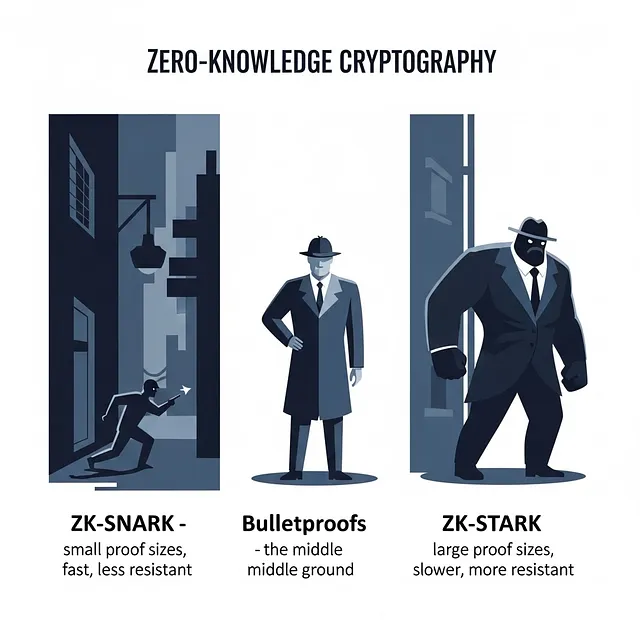
Each of these families solves the same underlying problem in a different way, and the right choice depends entirely on what you're optimizing for: proof size, setup complexity, or computational flexibility. If you want to go deeper on any of these, Ethereum co-founder Vitalik Buterin's walkthrough of STARKs is the clearest explanation I've found for a technical but non-cryptographer audience, and the original STARK paper from Eli Ben-Sasson and his co-authors is freely available if you want the underlying mathematics.
What Is a Zero-Knowledge Virtual Machine (ZKVM)?
Zero-knowledge virtual machines, or ZKVMs, mark the shift from ZK as a specialized cryptographic trick into ZK as a general-purpose computing platform. I think of a ZKVM as a virtual computer built specifically to generate zero-knowledge proofs for any program running inside it, rather than one custom proof for one specific use case.
That distinction matters enormously for adoption. Before ZKVMs existed, building a zero-knowledge application meant hiring people with PhDs in cryptography to hand-craft a proof for each new use case. With a ZKVM, a developer writes code in a language they already know, often Rust, and the ZKVM handles proof generation underneath. RISC Zero is one production example: it runs as a RISC-V virtual machine and lets a developer prove the correct execution of ordinary Rust code without writing a single line of cryptography. That's the difference between requiring a small specialized team and letting an existing engineering team ship trust-verified applications on its own.
How AI Agents Use Zero-Knowledge Proofs
Here's where these two threads come together, inside what's increasingly being called the AI agent economy. As more economic activity shifts from humans to autonomous agent transactions, data itself becomes the asset being traded, whether that's a dataset, an insight, or access to a computational service.
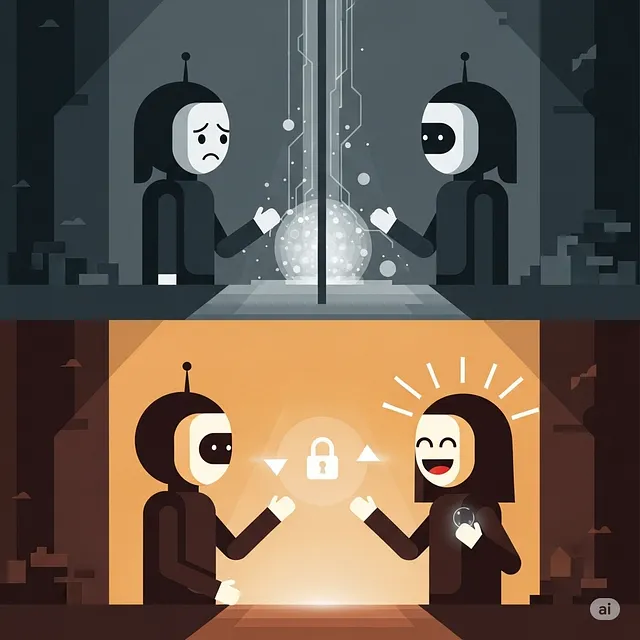
Consider two agents working through a transaction. Agent A offers to sell a dataset for a fixed price. Agent B will only pay if that dataset meets specific criteria, say a minimum number of unique records or a particular accuracy threshold. Without zero-knowledge proofs, Agent B has two options: trust Agent A's claim about the dataset, or bring in a centralized mediator to verify it. Both options undermine the autonomy that made agent-to-agent commerce appealing in the first place.
Zero-knowledge proofs change that equation entirely. Agent A can prove cryptographically that the dataset meets Agent B's criteria without revealing the dataset itself. Agent B gets certainty, Agent A keeps its asset protected, and neither party needs to trust the other or lean on a referee.
ZKVMs extend this further by allowing programmable negotiation logic instead of one-off proofs. Two agents can upload a program that encodes the full rules of a negotiation, including contingencies and verification steps, and that program runs automatically while producing a cryptographic proof of compliance at every stage. Each completed and verified transaction adds to an agent's track record, building a reputation system over time that rewards reliable behavior with access to higher-value exchanges.
Real-World Examples: Starknet, zkSync, and Zero-Knowledge Rollups
This isn't a hypothetical future. Validity rollups like Starknet and zkSync already use zero-knowledge proofs to process real transactions and secure real value on Ethereum. That ecosystem moves quickly enough that any specific transaction count or token price I quoted here would likely be wrong within weeks of publishing, so I'm deliberately leaving those numbers out. Polygon's own zkEVM mainnet beta, an Ethereum-compatible virtual machine built around zero-knowledge proofs, is being fully sunset on July 1, 2026, as Polygon consolidates its zero-knowledge work into its newer AggLayer architecture. I find that timeline instructive on its own. This infrastructure is still young and still consolidating, which is exactly why it deserves close attention rather than being treated as settled.
The bigger opportunity sits outside blockchain entirely, though. Any industry that handles sensitive data, faces regulatory scrutiny, or needs to verify trust between parties, healthcare, financial services, supply chain, insurance, can use the same underlying proof technology without touching a token or a smart contract.

How to Message Zero-Knowledge Cryptography to Different Audiences
As a marketer, here's how I think about positioning this technology for different audiences:
When I'm positioning this for leadership audiences specifically, I lean on three angles. The risk angle: this lets a company verify compliance and capabilities without exposing the sensitive logic underneath. The competitive angle: a company can prove its value proposition without revealing the secret sauce that produces it. And the long-term angle: building this kind of trust infrastructure now prepares a business for a future where agent-to-agent transactions become routine.
A few mistakes show up again and again in how this gets pitched. Marketers open with the mathematics when the business problem deserves that opening line. They let the term "zero-knowledge" float as an abstraction without pairing it to a concrete benefit. They oversell how ready the technology is today, glossing over real limits that deserve a clear mention even while making the case for where this is headed. And they tie the entire conversation to blockchain, even though the real value of this technology reaches well beyond cryptocurrency.
Limitations of Zero-Knowledge Proofs and ZKVMs
I want to be straightforward about where this technology still struggles, since overselling readiness is exactly the mistake I just described. Generating a zero-knowledge proof can take meaningfully longer than running the underlying computation directly, sometimes by a factor of 100 or more. Proof generation time for a computation of size n typically scales close to n log n, which is part of why larger computations create disproportionately larger overhead. Combine that with the specialized hardware and expertise required, and you get a real barrier to adoption today.
That said, the trajectory looks a lot like the early days of cloud computing. Performance limitations that seemed prohibitive a decade ago gave way to architectural innovations that now power most of the digital economy without most users ever thinking about the infrastructure underneath. A growing set of zkVM-as-a-service providers are working through the same curve right now, abstracting away the low-level cryptography while keeping a flexible API on top for the agents and applications built above them.

Is This Technology Right for Your Business?
Before walking through how to act on any of this, it's worth answering a more basic question honestly: does your business actually have the kind of trust problem zero-knowledge cryptography solves, or are you reacting to a topic that's getting attention rather than a concrete need? I'd run through four questions before committing real time or budget.
Do you face a real choice between revealing something sensitive and earning someone's trust? Look at your actual workflows: a vendor security review, a data-sharing partnership, a compliance audit, a customer asking how a pricing or recommendation decision got made. If you regularly hit moments where you either expose proprietary data and logic or ask someone to trust you blindly, that's the exact problem this technology was built to solve. If you can't point to a specific recurring moment like that, the rest of this list matters less.
Are AI agents already handling, or about to handle, transactions or negotiations on your behalf? A company running autonomous agent-to-agent commerce today has urgent reasons to care about this. A company still mostly using AI for internal copilots and drafting has more time, though building the messaging now, while the conversation is still forming, is its own advantage regardless of timeline.
Does your industry face heavy regulatory or verification requirements? Healthcare, financial services, insurance, and supply chain all involve constant proof-of-compliance work, and all of them can use the underlying technology without touching a token, a smart contract, or anything resembling crypto. If your industry lives inside that kind of scrutiny, the case for paying attention now is stronger than it looks from the outside.
Do you have the engineering bandwidth, or the budget for a vendor, to actually build something? This is the most overlooked question, and the most important one. Generating a zero-knowledge proof still costs real compute and real specialized expertise today, even with zkVM platforms abstracting away the cryptography. If the honest answer is "not yet," the right move is watching the space and building your positioning, not committing engineering time you don't have.
If you answered yes to the first question and at least one of the other three, this is worth acting on now rather than later. Here's where I'd start.
Map where your own trust problem actually lives. Walk through your product, your sales process, or your compliance workflow and find the specific moments where you currently have to choose between revealing something sensitive and asking someone to trust you blindly. Those specific moments are your candidate use cases, not "zero-knowledge cryptography" as a vague initiative on a roadmap.
Decide whether you need a single proof or an ongoing relationship. A one-time compliance check might only call for a basic ZKP. An agent negotiating or transacting repeatedly with the same counterparty is a better fit for a ZKVM, since the proof logic needs to keep running rather than fire once and stop.
Talk to your engineering team about proof-as-a-service options before assuming you need to build proving infrastructure from scratch. A platform like RISC Zero lets a team prove Rust code without hiring a dedicated cryptographer, which is usually the fastest way to test whether this is worth pursuing at all before committing real budget to it.
Build your messaging now, using the audience framework above, even before engineering ships anything. The companies that get ahead of this conversation, instead of reacting once a competitor announces something first, are the ones that get to define what "zero-knowledge" means to their market rather than inheriting someone else's definition of it.
If you're working through whether this technology fits your own product or go-to-market strategy, I'd genuinely enjoy the conversation.
If this connects to something you're trying to solve, book a complimentary consulting session. No pitch, just perspective.
FAQ: Zero-Knowledge Proofs and ZKVMs
What is a zero-knowledge proof?A zero-knowledge proof is a cryptographic method that lets one party, the prover, convince another party, the verifier, that a statement is true without revealing anything beyond the truth of that statement. The concept came from a 1985 paper by Shafi Goldwasser, Silvio Micali, and Charles Rackoff at MIT.
What's the difference between ZK-SNARKs and ZK-STARKs?ZK-SNARKs produce very small, cheap-to-verify proofs but require a one-time trusted setup. ZK-STARKs need no trusted setup and resist future quantum attacks, but their proofs are larger. The right choice depends on whether proof size or setup risk matters more for a given use case.
What is a zkVM?A zero-knowledge virtual machine, or ZKVM, is a general-purpose computing platform that generates zero-knowledge proofs for any program running inside it. Instead of hand-crafting a proof for each new use case, a developer writes ordinary code, often in Rust, and the ZKVM handles proof generation underneath.
How do AI agents use zero-knowledge proofs?An AI agent can use a zero-knowledge proof to demonstrate that a dataset, computation, or compliance check meets a counterparty's requirements without revealing the underlying data or logic. That removes the need to either expose proprietary information or rely on a centralized mediator to verify claims between agents.