
SAP's investment in n8n this May doubled the company's valuation to $5.2 billion in under a year, embedding n8n as the workflow layer inside Joule Studio, SAP's own agent-building platform. I think that deal settled an argument marketing and operations leaders have been having since Google shipped Antigravity: the winning agent-first platforms are the ones with a governed workflow engine running underneath them.
Antigravity is an agent-first platform for goal-driven, exploratory work like research, content, and software development. n8n is a workflow engine for repeatable, auditable execution, and after the SAP deal, it increasingly runs underneath agent platforms rather than beside them as a separate tool. Marketing and operations leaders need to decide which layer of the stack each tool should own.
The Three Layers of Automation, Once You Strip Out the Marketing
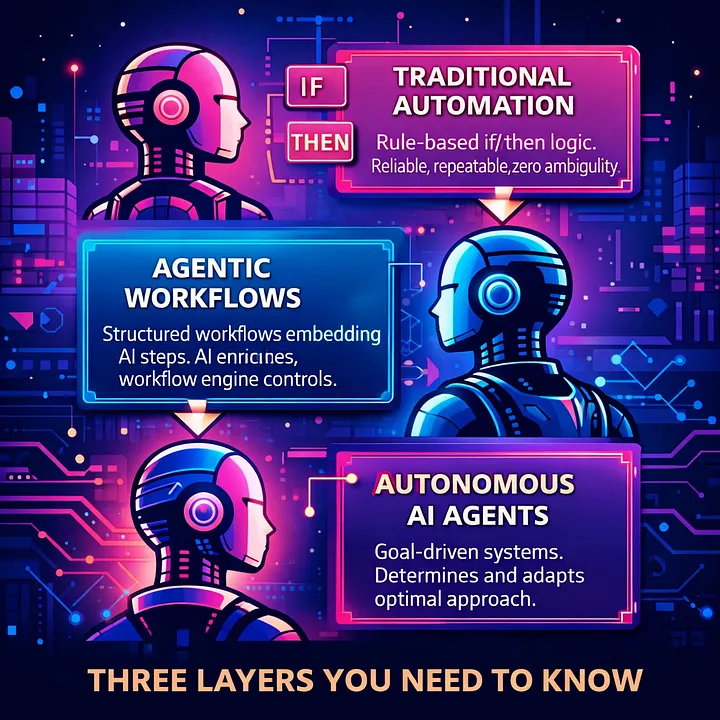
Traditional automation is rule-based if-then logic. Think Zapier. If someone fills out a form, send them an email. It is reliable, repeatable, and free of ambiguity, because the machine does exactly what you told it to do and nothing more.
Agentic workflows sit in the middle. These are structured, deterministic flows that embed AI steps, such as classifying an inbound message or summarizing a document, while the orchestration logic stays inside a workflow engine. The AI enriches individual steps; the workflow engine keeps ownership of the sequence.
Autonomous AI agents are goal-driven. You hand the system an outcome, and it figures out the path: choosing tools, retrying when something breaks, adapting when the context shifts. Nobody pre-designed the workflow. The agent builds it as it goes.
Most teams I talk to are trying to jump from layer one straight to layer three without realizing layer two exists. That gap is where most AI automation projects stall out.
Agentic AI vs. Workflow Automation: How Much Control Should You Keep?
This debate comes down to how much control you want to retain, and what that control costs you in speed.
The decision comes down to what the process actually demands. Financial reconciliation needs an airtight audit trail. Content strategy benefits from an agent that can explore, propose, and adapt. Those are different jobs, and expecting one tool to handle both is how you end up with neither working properly.
When Agent Abstraction Helps, and When It Puts Compliance at Risk
There is a seductive pitch behind agent-first tools like Antigravity: describe what you want, and it handles the rest. If you have ever spent an afternoon untangling a library of brittle workflow nodes, that pitch sounds like relief.
In plenty of contexts, it genuinely is relief. When you are resource-constrained, when your team lacks deep technical depth, or when the task is exploratory and hard to specify upfront, abstracting the workflow cuts friction without adding real risk. Need copy for a product launch? Need a competitor analysis structured for a board deck? Describe the outcome, review the artifact, ship it.
But abstraction has a shadow side. In regulated processes, finance, compliance, and customer data handling, someone in the organization has to be able to answer a simple question: what happened at step four, and why? A black-box agent that "tried some things" is not an acceptable answer when an auditor comes knocking. And when a pipeline breaks at two in the morning, the on-call engineer needs a workflow graph they can read in real time.
Agentic automation should abstract intent, never accountability. Take the plumbing out of view. Never take the governance out of reach.
What's New in Google Antigravity 2.0?
Google pushed Antigravity much further at Google I/O in May 2026 with Antigravity 2.0: a standalone desktop app for orchestrating multiple agents at once, a command-line interface for developers who would rather work in a terminal, and a software development kit for building custom agents on top of the platform. The original Antigravity shipped in public preview in November 2025 alongside Gemini 3, positioned as an agent-first development platform built around an editor view and a manager view for orchestrating multiple agents. Google Cloud customers can now connect Antigravity directly to project development, and enterprise customers get custom templates through Google's AI Studio. Antigravity is Google's entry in a field where OpenAI, Amazon, and Microsoft are each betting on a different vision of what an agentic AI platform should own.
Two additions matter most for this debate. First, Antigravity 2.0 added scheduled tasks with cron scheduling, which means an agent can now run on a timer the same way an n8n workflow does. Second, Google widened Antigravity's stated use cases beyond coding into marketing workflows and scientific research. The line between "agent" and "workflow tool" is getting blurrier by the release cycle, though it does not change the underlying accountability problem.
Pricing shifted too. Antigravity now runs a free tier, a $20-per-month Pro plan, a new $100-per-month Ultra plan for lighter, regular use, and a top-tier Ultra plan that dropped from $250 to $200 per month. The $100 tier gets five times the quota of Pro; the $200 tier gets twenty times the quota. For a tool built to replace hours of strategic setup work, that is a meaningful drop in the cost of entry, though the number worth watching is token consumption, the variable that makes vendor pricing pages so hard to compare once real usage starts hitting cache misses and long generations.
Why Is SAP Embedding n8n Into Its AI Agent Platform?
SAP is embedding n8n as the workflow layer inside Joule Studio, its own agent-building platform, because enterprise customers need a governed, auditable execution layer under their AI agents, and n8n already has the integrations and adoption it would take SAP years to build from scratch. The strategic investment behind that decision, made in May 2026, doubled n8n's valuation from $2.5 billion to $5.2 billion in less than a year. The result is a visual, flexible automation canvas inside Joule Studio that supports no-code, low-code, and pro-code development side by side.
SAP bought the best workflow engine on the market and plugged it in directly beneath its agent platform, rather than building its own. n8n now counts more than 1,400 enterprise customers and 1.7 million monthly active builders, with over 1,000 pre-built integrations across business tools, databases, and AI models, and an effectively unlimited ceiling above that thanks to its generic HTTP request node.
n8n's own team has started saying the quiet part out loud. In a recent post on how AI agent development tools have evolved, they argue that coding agents are for coders, and that no responsible non-developer knowledge worker should be writing custom applications and expecting to maintain them. That is n8n staying in its lane on purpose, while it keeps adding AI capability inside workflows. The lane is workflow orchestration with AI steps built in.
So, Will Google Antigravity Replace n8n?
Still no, at least not in any organization that takes operational reliability seriously. What is more likely, and what is now actually happening at enterprise scale, is that the two compose together. Antigravity handles the high-level, goal-oriented, creative, and strategic work. n8n manages the underlying, policy-bound, repeatable execution. In a mature stack, an Antigravity agent might trigger an n8n workflow to handle the parts of a task that need to be auditable, deterministic, and logged, exactly the pattern SAP just built into Joule Studio.
Picture a marketing team running a lead nurture campaign, exactly the kind of workflow where the line between agentic AI and marketing automation gets tested in practice. Antigravity drafts the segments, writes the copy variants, and proposes the experiment logic. n8n sends the emails, syncs engagement data back to the customer relationship management (CRM) system, updates lead scores, and enforces the do-not-contact list. Together, the two tools make up the automation stack.
How to Choose Between Google Antigravity and n8n
If you are in a regulated industry, or if operational reliability is non-negotiable, start with the workflow-first approach. Build your critical pipelines on a tool like n8n, where every step is visible and testable. Add AI capabilities selectively, inside the workflow, where you can control the blast radius of a bad output.
If you are in a growth context, focused on product velocity and team output, pilot an agentic platform like Antigravity on lower-stakes domains first. Let it help your team move faster on content, research, and strategy. But be deliberate about where your critical-path processes live. Those belong in a governed, observable layer of your stack regardless of how sophisticated your agents become.
The teams that win over the next two years will be the ones that understood which layer of the stack each problem belongs to, and built accordingly. What your systems can execute and what they can actually judge is the whole game.
If this connects to something you're trying to solve, book a complimentary consulting session. No pitch, just perspective.
Frequently Asked Questions
Is Google Antigravity a replacement for n8n?
No. Antigravity is an agent-first platform built for goal-driven, exploratory work like research, content, and application development. n8n is a workflow engine built for repeatable, auditable execution. SAP's decision to embed n8n inside its own agent-building environment in 2026 is a strong signal that agent platforms need a governed execution layer underneath them.
What is the difference between agentic AI and workflow automation?
Workflow automation, the kind n8n runs, follows a graph you can read: step one triggers step two, every branch is visible, every failure is logged. Agentic AI, the kind Antigravity runs, is handed an outcome and decides its own path, choosing tools and adapting as it goes. The trade-off is control versus adaptability.
Should a regulated business use Google Antigravity for critical processes?
Not for anything that needs a real-time audit trail. Antigravity's artifact system gives you task lists, screenshots, and recordings to review after the fact, but that is not the same as a workflow graph an auditor or on-call engineer can read while a process is running. Keep compliance-sensitive work, like financial reconciliation or customer data handling, inside a governed workflow tool.
How much does Google Antigravity cost in 2026?
Antigravity offers a free tier, a $20-per-month Pro plan, a $100-per-month Ultra plan aimed at lighter regular use that launched in May 2026, and a $200-per-month top-tier Ultra plan, down from its original $250 price. Enterprise teams can also reach Antigravity through Google Cloud's Gemini Enterprise Agent Platform.
Why did SAP invest in n8n?
SAP made a strategic investment in n8n in May 2026 that helped push the company's valuation from $2.5 billion to $5.2 billion in under a year. SAP is embedding n8n as the visual automation canvas inside Joule Studio, its own agent-building environment, so enterprise customers get a governed execution layer under their AI agents by default.
Can n8n and Google Antigravity work together in the same stack?
Yes, and that is closer to how most mature stacks will actually look. An Antigravity agent can handle the strategic, exploratory front half of a task, like drafting content or proposing an experiment, then hand off the deterministic, policy-bound back half, like sending emails or updating a CRM, to an n8n workflow that logs every step.
What is the three-layer automation framework?
Layer one is traditional rule-based automation like Zapier: if this, then that, with zero ambiguity. Layer two is agentic workflows, where a workflow engine like n8n embeds AI steps such as classification or summarization but keeps the orchestration logic. Layer three is autonomous AI agents like Antigravity, which are handed a goal and construct their own path to it.
Which automation layer should I build first?
Start wherever your risk tolerance is lowest. If a process touches money, compliance, or customer data, build it as a governed workflow first and add AI selectively inside it. If the work is exploratory, like content, research, or strategy, an agentic platform can move faster with less setup, because a wrong turn there costs you time.