I’ve had the same conversation with three different founders this year. They see a campaign performing well at a modest budget, decide to scale aggressively, convinced that a campaign converting well at $15K will convert just as well at $150K, and then watch their cost per acquisition silently double while total conversions barely move.
Every time, they reach the same conclusion: if the numbers are slipping, the fix must be scale, blaming the outcome on bad leads, the need for additional audiences, or not casting a wider strategic net. They expand targeting, loosen demographic constraints, push into new segments. The conversion rate keeps falling and they keep interpreting that as a signal to grow the audience further, when it’s actually the audience growth that’s causing the problem in the first place.
This is one of the most predictable failure modes in growth marketing, and it’s almost never named directly. There’s a mathematical inverse relationship between audience size and conversion efficiency that’s baked into how digital channels work. It’s a structural property of how attention and relevance distribute across a market. The founders I’ve watched struggle with this aren’t bad marketers. They’re operating without a model that tells them when to stop, which budget expansion should buy them more customers versus more noise, and why a campaign that was working at $15K a month can quietly fall apart at $50K without a single creative or targeting change. Once you build that model, the failure mode becomes predictable, the conversation with your CFO becomes a planning exercise instead of a post-mortem, and scaling becomes a decision you make deliberately rather than a cliff you walk off by accident.
Why platforms serve you worse audiences as you scale
When you launch a campaign at small scale, the platform’s algorithm does something that works in your favor: it shows your message to the people most likely to care, the highest-intent users in your addressable market who are already predisposed toward what you’re selling, and your conversion rate reflects that quality because you’re essentially skimming the best-fit slice of your potential audience before the economics of scale have had a chance to dilute it.
As you raise your budget or widen your targeting, the algorithm has already served that first-rate segment. Now it dips into the second tier. Then the third. Each expansion pulls in people who are incrementally less likely to convert. You’re paying roughly the same cost per impression, but you’re buying worse and worse attention. Andrew Chen called a version of this the “Law of Shitty Clickthroughs” — banner ads launched in 1994 with a 78% CTR, and by 2011 the average had collapsed to 0.05%. The channel didn’t break; the conversion rate fell as it scaled.
The math behind audience size and conversion rate decay
You can model this with a simple power function. As audience size grows, conversion rate follows:

Where A is your audience size, k is your baseline conversion efficiency, and α captures how fast quality decays as you scale (typically between 0 and 1). For a realistic B2B or high-intent SaaS campaign, a reasonable fit looks something like:

Total conversions are just A×CR(A), which rises with scale but with a flattening slope. The more punishing number is customer acquisition cost. If your average cost per click is roughly fixed at some value C:

As conversion rate shrinks, CAC balloons. That’s not bad targeting but the denominator, CR(A), collapsing.
Audience size vs. CAC: what the numbers actually show
The table below models a simulated audience scaling curve based on the power function described above, built to illustrate how conversion rate and CAC move in practice as reach expands.
Scaling from 1K to ~400K reach multiplies conversions about 100x, but conversion rate drops 3–4x and CAC more than triples. Push past 400K to 1M and you barely add conversions while your CAC nearly triples again. You’re now deep in the overspend zone. The shape of this curve is consistent with ad response modeling documented by practitioners at muttdata.ai and others working in media mix modeling.
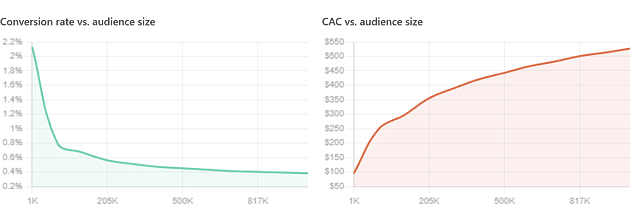
The left chart below shows conversion rate collapsing as audience size grows, falling from above 2% at small scale to a fraction of a percent by the time you reach a million people. The right chart shows what that collapse costs you in dollars: a CAC that starts around $90 at a tight, high-intent audience and climbs toward $1,000 as you push into the long tail of people who were never going to buy from you anyway.
How to use marginal CAC to reset executive expectations
The hardest part of this isn’t the math. It’s the meeting where you explain why 10x the budget will not produce 10x the results.
Here’s the frame I use: marginal CAC. Forget blended CAC. What matters is the cost of your next customer, not the average of all your past ones.

If raising your budget from $15K to $17.5K produces 100 additional customers, your marginal CAC is $25. That number tells you whether you’re still in efficient territory or whether you’ve crossed into diminishing returns. Blended CAC can look perfectly healthy while marginal CAC is already at 3x your target.
The pitch to your CFO: “Here’s the response curve. Here’s our target CAC band. Here’s the audience size where we stop.” That framing converts budget conversations from arguments into planning.
How to scale audience reach without destroying conversion efficiency
This doesn’t mean you can’t grow. It means you have to grow deliberately.
First, protect your high-intent segments. Retargeting pools, cart abandoners, engaged trial users are already on the efficient part of your curve, and they deserve dedicated budgets with tighter CAC targets before you spend a dollar on cold audiences.
Second, scale horizontally before vertically. New geos, new ad sets, new lookalikes open fresh audience pools with their own efficient frontiers instead of burning through one exhausted one, and big vertical budget jumps force algorithms into worse inventory bands overnight.
Third, and most importantly, improve conversion after the click. This is the only move that actually shifts the entire response curve upward. Better landing pages, sharper offers, and cleaner onboarding flows mean that when your underlying conversion rate improves, you can profitably reach more people at the same CAC threshold. You’re not just managing where you are on the curve. You’re moving the curve.
The inverse relationship between audience size and conversion rate is real, it’s predictable, and it’s manageable. But only if you name it, model it, and plan around it before someone hands you a bigger budget and expects you to scale the unscalable.