
Your CEO just handed you a brand-new wallet-tracking tool and wants weekly metrics on how many crypto wallets you've reached. Suddenly, all your old standbys (CPC, CAC, conversions) feel inadequate, and the real question in Web3 is no longer who clicked an ad but how many wallets you are actually engaging and converting into loyal dApp users and token holders.
A new field of metrics is emerging in blockchain marketing: wallet-based marketing and measurement. In this guide, I'll walk through why Cost Per Wallet (CPW) is becoming the defining metric of blockchain marketing, how to calculate it, which tools support it, and how shifting your reporting to wallet analytics changes your growth strategy in ways that traditional Web2 measurement cannot replicate.
Why Web3 Marketers Are Replacing CPC with Cost Per Wallet (CPW)
For years, Web2 marketers have relied on impressions, clicks, and conversions to measure campaign performance, thinking in terms of cost per click (CPC), cost per impression (CPM), or customer acquisition cost (CAC). These metrics fail to capture the unique behaviors of Web3 users, who may hold multiple tokens, frequent multiple DeFi protocols, or flip NFTs across different marketplaces, and whose most meaningful actions never register as signals inside a traditional analytics dashboard.
In a Web3 context, winning a click is far less meaningful than converting a wallet and observing that wallet's on-chain activity: whether that's minting an NFT, staking tokens, trading digital assets, or participating in governance. That shift in what constitutes a meaningful conversion is what makes cost per wallet a more precise and natively Web3 performance metric.
The differences compound quickly when you lay the two frameworks side by side:
Why CPW Is the Most Important Metric in Blockchain Marketing
When someone has an active wallet, they are fundamentally different from a casual website visitor or passive observer. A wallet-holder has, at minimum, taken the steps to install a crypto wallet solution (such as MetaMask or Coinbase Wallet), secured funds or tokens in that wallet, and demonstrated openness to deeper participation in Web3 ecosystems through NFT purchases, token deposits, blockchain gaming, or DeFi protocols.
As Asaf Nadler, co-founder of Addressable, has noted, users with a crypto wallet installed are 18 times more likely to sign up and seven times more likely to convert to crypto products. That data point reframes the entire targeting problem: if your campaign reaches wallets, you are automatically filtering out the unengaged audience and focusing on people who are already operating inside Web3 and likely to explore your offering.
CPW effectively answers the question: for every dollar you spend in marketing, how many wallet-holders do you acquire? A lower CPW means you are attracting the right audience at an efficient cost, and unlike CPC, it maps directly to on-chain behavior you can independently verify.
How to Calculate Cost Per Wallet
Calculating CPW requires two data points: your total campaign spend and the number of net new wallets acquired (or activated) as a result of that campaign.
If you spent $100,000 across a multi-channel campaign and saw 2,000 net new wallets interact with your dApp, your CPW is $50. The formula itself is simple; the complexity lies in accurate attribution, which requires connecting wallet addresses to specific traffic sources, ad clicks, or promotional codes through on-chain analytics infrastructure rather than standard pixel-based tracking.
Beyond CPW alone, wallet lifetime value (WLV) gives you a longer-horizon view of acquisition efficiency:
These two formulas together give you the same acquisition-to-retention framework that growth marketers have always used in SaaS, adapted for an environment where the "account" is a pseudonymous on-chain address rather than an email address.
On-Chain Analytics Tools for Wallet-Based Marketing
Traditional Web2 analytics platforms serve you only partially here because they surface clickstreams and pageviews rather than on-chain transactions, and the two datasets rarely overlap cleanly. Web3-native data infrastructure needs to do four things that conventional tools cannot:
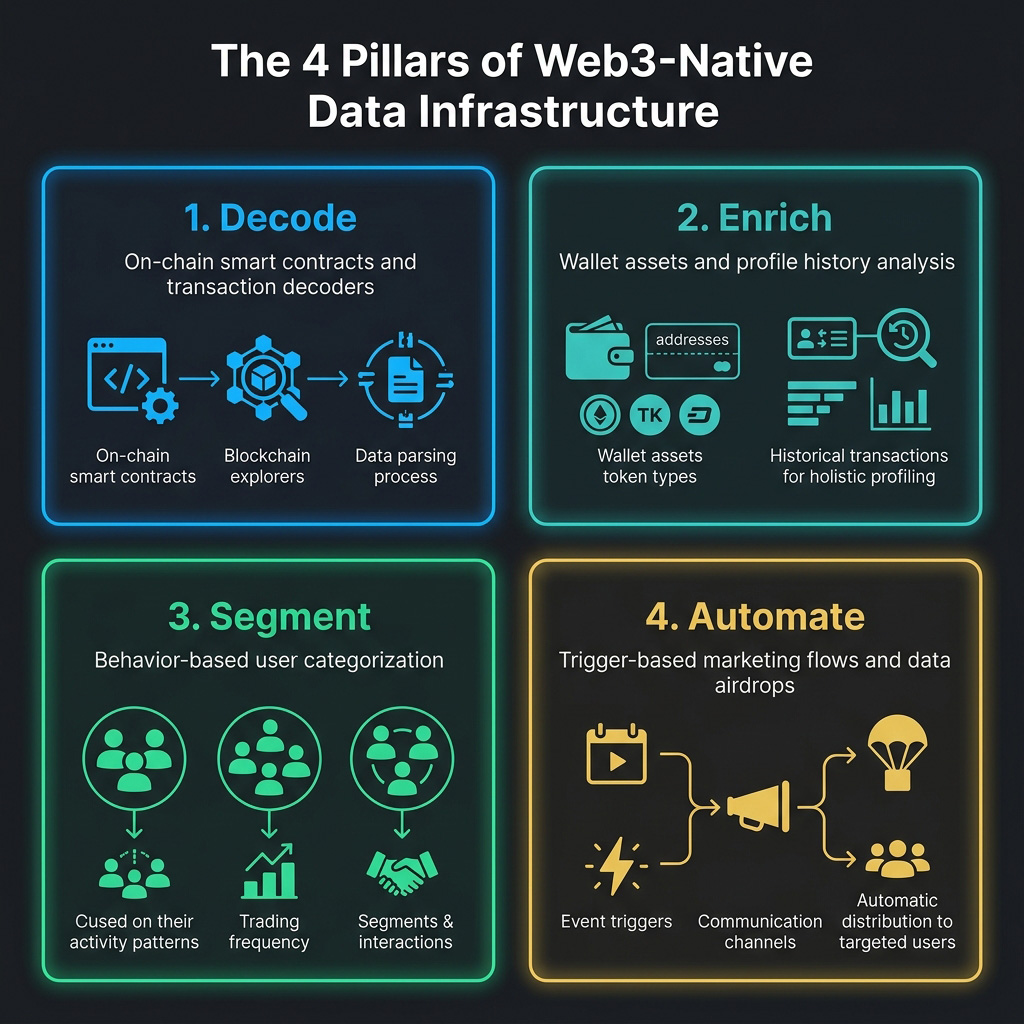
- Decode on-chain transactions at scale, observing which new addresses performed a first-time NFT mint, token deposit, or governance vote.
- Enrich wallet profiles by analyzing asset holdings, protocol history, and transaction frequency.
- Segment wallet users based on on-chain behavior, separating whales from novices, NFT collectors from DeFi participants, and active stakers from dormant addresses.
- Automate marketing flows that trigger messages or token airdrops when specific wallet milestones are hit, such as 30 days of dormancy or a first cross-protocol interaction.
The tooling ecosystem has matured to support these workflows. Nansen and Dune Analytics are the most widely adopted platforms for on-chain wallet intelligence, offering dashboards that track wallet activity, protocol engagement, and behavioral segmentation at scale. Addressable focuses specifically on wallet-based advertising attribution, connecting campaign spend to on-chain outcomes in ways that traditional ad platforms are not designed to do.
Two vendor categories have emerged to serve the broader infrastructure need:
CDP (Customer Data Platform) for Web3: These tools compile wallet addresses, portfolio values, transaction histories, and cross-protocol behavior into unified audience segments, bringing the same data richness that Segment or mParticle provides in SaaS to a pseudonymous, on-chain environment.
WRM (Wallet Relationship Management) platforms: WRM functions like a CRM built entirely on on-chain data. Rather than tracking email opens and form fills, a WRM platform tracks each wallet's activity across your protocol, automates airdrop campaigns and token rewards based on behavioral triggers, and surfaces reactivation opportunities when wallet activity drops below defined thresholds. For teams serious about lifecycle marketing in Web3, WRM is the infrastructure layer that makes sustained wallet engagement operationally feasible, and it represents the clearest structural parallel to the marketing automation stacks that SaaS growth teams rely on.
A peer-reviewed analysis of the NFT trading market covering 22.7 million sales transactions across 1.3 million customers found that blockchain data enables firms to observe their customers' share of wallet and competitor activity transparently and in real time, a level of market visibility that has no equivalent in Web2. That transparency is the structural advantage that makes on-chain analytics so valuable for marketers willing to invest in the tooling.
On-Chain ROI Metrics: Share of Wallet and Wallet Lifetime Value
Beyond CPW, the metrics that tell you how deeply engaged a wallet is center on two concepts borrowed and adapted from traditional marketing.

Size of wallet (total asset value held) indicates whether you are attracting larger spenders or early experimenters. This is useful for segmentation but does not on its own measure loyalty or intent.
Share of wallet measures the ratio of a user's on-chain activity directed at your protocol versus their total crypto activity. If a wallet invests $1,000 across multiple NFT platforms and directs $300 toward your project, your share of that wallet's NFT spending is 30%. Tracking this share over time indicates whether your engagement strategies are deepening loyalty or ceding ground to competing protocols, and it allows the same kind of competitive positioning analysis that traditional marketers apply to brand share of voice.
Potential wallet (the total capacity to spend or engage, based on on-chain assets) is what turns share-of-wallet analysis into a growth lever. If a significant portion of your user base holds substantial on-chain assets but directs little activity toward your protocol, that gap is a targeted upsell opportunity. This is where wallet-centric reporting shifts from measurement into growth strategy, a transition that most Web3 teams have not yet made. For a look at how attribution models connect to growth strategy more broadly, my post on broken lead scoring models covers the same underlying problem in a SaaS context.
Building a Wallet-Centric Reporting Mindset
Shifting from Web2 metrics to wallet-based reporting is an adjustment, but the payoff is disproportionate: greater precision in campaign measurement, better audience segmentation, and stronger correlations to actual on-chain conversions all compound once you have the attribution infrastructure built correctly.
To begin, sync your existing user funnels (sign-up forms, Discord invites, email captures) with your on-chain data. Define key funnel stages explicitly: "wallet created," "first NFT minted," "first token swap," "governance vote cast." Then measure conversion rates between stages the same way you would track a SaaS trial-to-paid funnel, using CPW as your primary acquisition efficiency metric and WLV as your retention efficiency metric.
The lifecycle marketing application extends well beyond acquisition. Reactivation campaigns targeting dormant wallets, cross-sell flows introducing DeFi or staking features to mid-level users, and VIP tiers for high-value wallets are all operationally achievable once you have WRM infrastructure in place. On-chain data makes the segmentation deterministic rather than probabilistic: you know what a wallet holds, not just what a user self-reported in a survey.
For teams building out the underlying analytics infrastructure, my post on CMO dashboard architecture using first-party data covers the reporting layer in more detail, including how to connect disparate data sources into a single performance view.
Wallet Data, Privacy Compliance, and Pseudonymity in Web3 Marketing
One structural advantage of wallet-based marketing is that wallet data is natively public and transparent. You can observe addresses and on-chain activity without relying on third-party cookies or self-reported user data, two sources that have become progressively less reliable as privacy regulations tighten globally.
That transparency does not eliminate privacy considerations. Many wallet owners prefer to remain pseudonymous, and certain jurisdictions impose compliance requirements on the use of behavioral data in marketing, even when that data originates from public ledgers. Building and maintaining user trust requires a clear stance: use on-chain data for aggregated marketing analysis, not for the unwanted identification of individual users.
Practically, this means explaining how you use wallet data, offering users meaningful opt-in opportunities for additional communications or perks, and demonstrating through product decisions that you value their sovereignty over their own data. The protocols that do this well tend to generate stronger community loyalty, which compounds into a growth driver of its own, because token incentives and governance participation create reinforcing engagement loops that no Web2 loyalty program can replicate.
Conclusion: The New Standard in Web3 Marketing
Success in blockchain marketing increasingly hinges on understanding and measuring wallet-based engagement, and the teams that build this infrastructure earliest will compound a significant structural advantage over those still optimizing for clicks.
By adopting CPW as your primary acquisition metric, building WRM infrastructure for lifecycle engagement, and analyzing on-chain data for share of wallet and wallet lifetime value, Web3 marketers can move beyond campaign output metrics and into genuine growth intelligence. The result is not just lower acquisition costs. It is deeper relationships with high-value crypto users, more defensible product adoption, and a marketing reporting framework that reflects what actually happens on-chain rather than what users might have done after seeing an ad.
The future of blockchain marketing starts and ends with the wallet. Once the metrics, infrastructure, and optimization loops are in place, measuring real ROI on Web3 campaigns becomes precise in ways that traditional digital marketing has never been.
Frequently Asked Questions
What is cost per wallet (CPW) in Web3 marketing?
Cost per wallet (CPW) is a blockchain-native marketing metric that measures how much a marketer spends to acquire one on-chain participant: a user with an active crypto wallet who has engaged with your protocol, minted an NFT, or completed a token transaction. It is calculated by dividing total campaign spend by the number of net new wallets acquired during the campaign period, and it is designed to replace click-based metrics that do not reflect meaningful Web3 user behavior.
How do you calculate cost per wallet?
CPW equals total campaign spend divided by net new wallets acquired. A $100,000 campaign that drives 2,000 new wallet interactions produces a CPW of $50. The formula is straightforward; the challenge is attribution, because connecting wallet addresses to specific traffic sources requires on-chain analytics infrastructure (such as Nansen, Dune Analytics, or Addressable) rather than traditional Web2 pixel tracking.
What is wallet relationship management (WRM)?
Wallet relationship management (WRM) is a category of marketing technology that functions like a CRM built on on-chain data. Rather than tracking email opens or form submissions, a WRM platform tracks each wallet's activity across your protocol, automates airdrop and token reward campaigns based on behavioral triggers, and surfaces reactivation opportunities when wallet engagement declines. It is the Web3 equivalent of lifecycle marketing infrastructure in SaaS, built for an environment where the user identifier is a pseudonymous wallet address rather than an email.
What analytics tools do Web3 marketers use to track wallet activity?
The most widely used on-chain analytics platforms are Nansen, Dune Analytics, Glassnode, and Addressable. Nansen and Dune provide wallet intelligence and behavioral segmentation at scale. Addressable specializes in connecting advertising spend to on-chain wallet attribution. For broader CDP (Customer Data Platform) functionality, tools like Formo compile cross-protocol wallet data into unified audience segments suitable for targeted campaign execution.
What is share of wallet in a Web3 context?
Share of wallet in Web3 measures the percentage of a user's total on-chain activity directed at your specific protocol or project. If a wallet spends $1,000 across NFT platforms and $300 of that goes to your project, your share of that wallet's NFT spending is 30%. Tracking this metric over time indicates whether your engagement strategies are deepening loyalty or losing ground to competing protocols, giving you a competitive positioning signal that has no equivalent in standard Web3 analytics dashboards.
How does on-chain attribution work in blockchain marketing?
On-chain attribution connects marketing touchpoints (ad clicks, referral codes, Discord invites) to verifiable on-chain actions (wallet activations, NFT mints, token swaps) by matching wallet addresses to campaign traffic sources. Unlike Web2 attribution, which relies on cookies and self-reported conversion events, on-chain attribution is cryptographically verifiable: the transaction either happened or it did not, with a permanent timestamp and wallet address recorded on the public ledger. This makes it the most auditable attribution model available in digital marketing.