
AI can now turn a plain-English description into a working app in an afternoon, so the scarce resource has moved upstream. The hard part is picking an idea worth building and a data source stable enough to build on. I think that second choice is where most vibe-coded projects quietly die, and 2026 proved it: the most popular free search API in my original version of this guide is now closed to new customers and shuts down on January 1, 2027.
The best free public sources for vibe coding app ideas are a search API (Tavily or Brave now that Google's Custom Search JSON API is retiring), a public API directory like publicapis.dev, GitHub's public repositories, the Awesome Public Datasets list, and the Internet Archive's APIs. Validate each source before you build, build with an AI coding agent like Claude Code or Google Antigravity, and ship on Vercel, Netlify, or Cloudflare. That four-step loop (browse, validate, build, ship) repeats across every source in this guide.
What is vibe coding?
Vibe coding is building working software mainly by describing what you want to an AI model in natural language, then steering the result, instead of writing each line of code yourself. Andrej Karpathy coined the term in February 2025, and Collins Dictionary named it its 2025 Word of the Year. The gap between an idea and a clickable prototype has shrunk from weeks to hours for a large class of small, data-backed tools. The decision about what to build has not shrunk at all.
Which free public APIs and data sources spark the best vibe coding app ideas?
Browsing beats planning. Most builders pick a dataset first and invent a use case around it, which produces apps that feel like homework. A better habit is to scroll public sources until one makes you think there's a real tool hiding in it. These five sources each open a different category of app.
1. Search APIs: Tavily and Brave (replacing Google Custom Search)
A search API is the fastest route to an app with obvious practical value. When I first wrote this guide, the Google Custom Search JSON API was my top pick: 100 free queries per day against a Programmable Search Engine you could scope to specific domains. Google has since closed it to new customers and given existing ones until January 1, 2027 to move. Google points site-scoped use cases (up to 50 domains) toward Vertex AI Search, which is a heavier, billed Google Cloud product.
For vibe coders, two replacements fit better. Tavily's free Researcher plan includes 1,000 API credits a month with no credit card, and a basic search costs one credit. Brave dropped its free tier in February 2026 and now gives $5 in monthly credit at $5 per 1,000 requests, which buys about 1,000 searches before your card is charged.
Those budgets are smaller than they look. Spread a monthly allowance across a month to see your real daily ceiling:
Here C is your monthly credit allowance and c is the cost per query in credits. Tavily works out to 1,000 ÷ (30 × 1), or roughly 33 basic searches a day. Brave's $5 credit lands at the same 33. Google's old free tier gave you 100 a day, so the new free ceiling is about a third of what it was. I see that as a feature. A tight quota forces a narrow prototype, and narrow prototypes tell you faster whether an idea has legs.
App ideas that fit inside 33 searches a day: a niche SERP (search engine results page) tracker for 10 fintech keywords, a title-tag pattern finder for one product category, or a content gap map for a single topic cluster.
Google Trends is the other search-adjacent source people reach for. The popular unofficial pytrends library was archived in April 2025 and gets no fixes when Google changes its endpoints. Google launched an official Trends API in July 2025, but it is still an application-gated alpha with no public timeline. Treat trend data as a stretch goal until that API opens up.
2. Public API directories
A public API directory is the best starting point for open-ended ideation. publicapis.dev lists more than 1,400 free APIs across 47 categories, from finance and weather to books and maps. Its value sits in the browsing itself. Two unrelated APIs side by side suggest products you'd never reach through a direct search.
A weather API next to a finance API suggests a "local weather versus market mood" microapp. A books API next to a maps API suggests a "which authors came from this city" explorer. A sports stats API next to a news API suggests a tool that tracks how coverage shifted during a win streak. Directory listings age unevenly, and some point at APIs that changed their authentication or died. Use the directory to find ideas, then verify each API on its own docs page.
The Postman API Network adds a 2026 twist here. Postman can generate an MCP (Model Context Protocol) server from public APIs in its network, which lets an AI coding agent call those APIs as tools while it builds your app.
3. GitHub public repositories
GitHub works in two directions at once: as a library of code and as a library of build ideas. Good apps on top of GitHub search include a starter-kit curator that finds the most-starred repos for a given stack, a trend explorer that tracks which project types are gaining momentum, and a "find me open-source examples of X" interface. Plan around the REST API rate limits: 60 requests an hour without authentication and 5,000 with a personal access token.
Public repos carry real security risk. In 2024, Apiiro documented a repo confusion campaign that cloned legitimate repositories, injected malware, and republished them, with more than 100,000 infected repos identified. If your app surfaces GitHub content to other people, say so in the interface, and never paste code from a public repo into your own project without reading it first.
4. Awesome Public Datasets
Awesome Public Datasets is a community-maintained, MIT-licensed GitHub list of open datasets, grouped by topic across economics, biology, sports, government, climate, and more. With roughly 78,000 stars, it is one of the most-used open data indexes on GitHub. It suits builders who want a subject to anchor the app instead of an API capability, because the dataset often implies the product. A government spending dataset suggests a budget explorer. A climate dataset suggests a regional trend visualizer.
The workflow is simple. Pick one niche dataset. Identify the search or filter behavior the data invites. Build the thinnest possible interface around that single interaction. The list is only as current as its maintainers, so validate each linked dataset's freshness and documentation before you commit.
5. Internet Archive APIs
The Internet Archive shifts the question from "what can I search right now" to "what changed over time." Its Metadata API returns item metadata in a single request, which powers archive search tools, book lookups, and historical content comparisons. The Wayback Availability API tells you whether a URL has an archived snapshot and returns its timestamp, which makes "how did this page look five years ago" apps easy to prototype.
The Archive now publishes explicit guidance for bots and LLM-driven tools. Every automated request needs a descriptive User-Agent that names your tool and version, and for AI agents, the model in use. Add delays for bulk work and honor 429 responses. Tell your coding agent about these rules in the first prompt, because it will not guess them. The corpus is enormous, so a vibe-coded prototype here needs stronger filters and UI guidance than a narrowly scoped API app.
What do you owe your public sources on attribution and licensing?

If your app shows data, code, or content that came from somewhere else, users should be able to see where it came from. That protects you legally, and it builds trust with people who want to verify what they're reading. The rules vary by source.
Build a visible attribution line into your interface from day one. Retrofitting one after launch is always harder.
What security risks come with vibe coding on public sources?
The newest risk comes from the AI itself. Coding models sometimes recommend software packages that don't exist, and attackers register those invented names with malware inside. Security researchers call this slopsquatting. A USENIX Security 2025 study of 16 code-generating models found hallucinated packages in 5.2% of commercial-model outputs and 21.7% of open-source-model outputs. A 2026 follow-up from Socket tested five frontier models on nearly 200,000 responses and still found rates between 4.62% and 6.10%, plus 53 invented package names that anyone could register.
The fix takes seconds. Before you approve an install, check that each package exists on npm or PyPI, has real download history, and matches the name in the official docs. Combine that habit with the GitHub caution above, and you've covered the two most common ways a weekend project ships someone else's malware.
Which AI coding tools fit each stage of a vibe coding build?
Each tool earns its place at a specific stage. Treating them as interchangeable wastes time.
Validate with Perplexity. Spend fifteen minutes asking whether the API is actively maintained, what developers report about its reliability, and what limits you'll hit. Cited answers can save you a day on a source the community already abandoned. The Google Custom Search shutdown is exactly the kind of thing this step catches.
Build with Claude Code when you want control. Claude Code can inspect an API, write a test request, run it, read the JSON response, and start scaffolding the app in one agentic loop. That merges source exploration and building into a single step. It works best when you already know what the finished app should do. Speed of generation never replaces your judgment on architecture and security.
Build with Google Antigravity when you want autonomy. Antigravity is Google's agent-first development platform, and Antigravity 2.0 launched at Google I/O on May 19, 2026 as a standalone desktop app with a new CLI (command-line interface) and an SDK in preview. Gemini 3.5 Flash is now its default model. It suits builders who'd rather describe an outcome and let orchestrated agents handle more of the sequence.
Explore the wider agent field. OpenAI's Codex, Devin from Cognition, and Cursor's agent mode each split the work between agent and developer differently. Capability gaps between these tools keep narrowing, so pick based on how much autonomy you're comfortable handing over.
Graduate to Postman later. Once a project involves multiple API environments, collaborators, or formal endpoint documentation, Postman's workspaces and testing earn their setup cost. For a solo prototype, they add ceremony you don't need yet. (Disclosure: I previously held a marketing leadership role at Postman.)
Where should you host a vibe-coded app?
Pick hosting based on how much server-side logic your app needs. Choosing early also keeps your scope honest.
One update since April: on Cloudflare, start new projects on Workers with static assets instead of Pages. Pages is still supported, but Cloudflare's own migration guide notes that Workers has a broader feature set, including Durable Objects, Cron Triggers, and better observability, and that static asset requests on Workers are free. A source-backed app that later needs a scheduled data refresh will thank you.
Vercel's free Hobby plan covers personal, non-commercial projects. If your tool starts serving a business, budget for a paid tier.
What is a repeatable framework for going from inspiration to a shipped app?
The whole workflow runs in four stages, and you can repeat them with any source above.
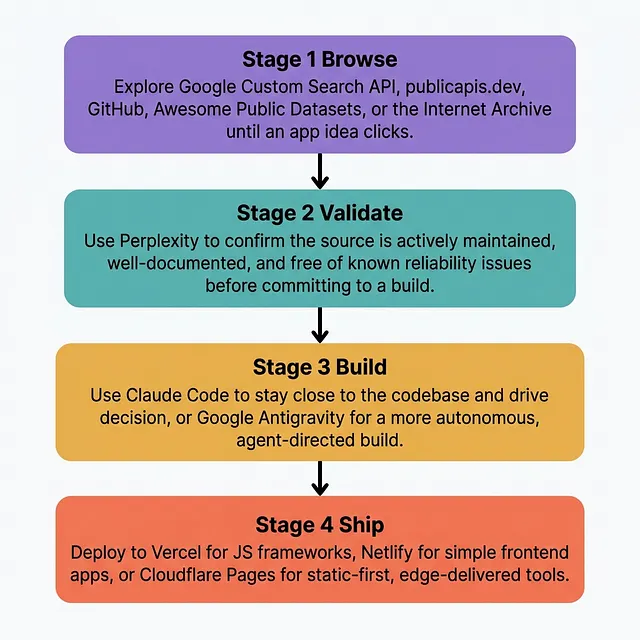
- Browse. Explore public sources until an idea clicks. At this stage you only need a spark.
- Validate. Use Perplexity to confirm the source is maintained, documented, and still open to new users. Check the free quota and do the daily-budget math.
- Build. Use Claude Code to stay close to the code, or Antigravity for a more autonomous build. Give the agent the source's rate limits and attribution rules in the first prompt, and verify every package it installs.
- Ship. Deploy to Vercel for JavaScript frameworks, Netlify for simple frontends, or Cloudflare Workers for static-first, edge-delivered tools.
The framework's value is repeatability. The same four stages that take you from a GitHub repo to a live search tool on a Tuesday will take you from the Internet Archive to a historical content explorer the following week. The sources rotate and the ideas change. The path stays the same.
The bigger shift is who gets to build. A marketer with a search research idea, a researcher who wants a custom dataset explorer, and a founder testing a hypothesis before committing to a roadmap no longer need an engineering sprint. The public sources are there, the agents are capable, and hosting costs close to nothing. Your next app starts with twenty minutes of browsing.
Frequently asked questions
What is vibe coding?
Vibe coding is building functional software mainly through natural language prompts to an AI model, describing the outcome you want instead of writing the code line by line. Andrej Karpathy coined the term in February 2025, and Collins Dictionary named it its 2025 Word of the Year. Tools like Claude Code and Google Antigravity let a solo builder go from idea to working prototype in an afternoon.
What is the best free public API for building a vibe-coded app?
For a search-aware app, Tavily is the easiest free starting point in 2026: 1,000 API credits a month with no credit card, at one credit per basic search. Brave's Search API is a strong alternative with $5 in monthly credit. For open-ended ideation, publicapis.dev lists more than 1,400 free APIs across 47 categories.
Is the Google Custom Search JSON API still available?
No, not for new projects. Google has closed the Custom Search JSON API to new customers, and existing customers have until January 1, 2027 to move to an alternative. Google recommends Vertex AI Search for searching up to 50 domains.
Is there an official Google Trends API?
Google launched an official Google Trends API in July 2025, but it remains an application-gated alpha with no public release date. The unofficial pytrends library was archived in April 2025 and receives no maintenance, so it can break whenever Google changes its endpoints.
Is it safe to use public GitHub repositories as a data source?
Public repositories are not automatically safe. In 2024, Apiiro identified more than 100,000 repositories infected through a repo confusion campaign that cloned and poisoned legitimate projects. Read any code before reusing it, check its license, and label GitHub content clearly if your app shows it to other users.
What is slopsquatting, and how do I avoid it?
Slopsquatting is an attack where criminals register software package names that AI models invent, so an AI-suggested install pulls in malware. A USENIX Security 2025 study found hallucinated packages in 5.2% of commercial-model outputs and 21.7% of open-source-model outputs. Before approving any install, confirm the package exists on npm or PyPI, has real download history, and matches the official docs.
What is the difference between Claude Code and Google Antigravity for vibe coding?
Claude Code keeps you close to the code, handling tasks like API inspection, feature generation, and debugging while you drive each decision. Google Antigravity is agent-first: you describe an outcome and orchestrated agents carry out more of the steps. Antigravity 2.0, launched May 19, 2026, added a standalone desktop app, a CLI, and an SDK in preview.
How do I deploy a vibe-coded app for free?
Vercel, Netlify, and Cloudflare all offer free tiers that cover most early-stage vibe-coded apps. Use Vercel for JavaScript framework apps, Netlify for simple HTML/CSS/JS projects, and Cloudflare Workers with static assets for static-first apps that need edge delivery. Vercel's free Hobby plan is limited to personal, non-commercial use.