If my misplaced private keys were an alt-coin, I'd be a crypto whale by now. But that's the point: this space moves at a pace that embarrasses most industries, and the security threats evolving alongside it are every bit as fast. In the time it takes most marketing categories to update their brand guidelines, blockchain has gone from a financial curiosity to critical infrastructure for healthcare, logistics, and global trade.
That speed creates a specific problem for those of us on the marketing side: the threats are real, the technology is genuinely complex, and the audiences we're trying to reach (enterprise buyers, crypto-native users, compliance officers, board members) need someone to translate all of it into something they can act on.
This guide breaks down how blockchain security has evolved, the attack vectors worth understanding, four trends that will define the next eighteen months, and the messaging strategies that actually close the gap between technical reality and audience confidence.
The Evolution of Blockchain Security
Blockchain started as the engine behind Bitcoin. The original design was elegant: a distributed ledger verified through cryptographic consensus rather than controlled by any central authority. Because no single entity owns the ledger, there is no single point of failure for an attacker to target. That decentralization was not just an architectural choice; it was the security model.
Then enterprise adoption arrived, and the elegant original met the messy reality of regulated industries. Banks, healthcare systems, and logistics companies started building on blockchain, and the security question changed shape. Decentralization remains a genuine advantage, but weak governance structures, third-party integrations, and undertrained end users create vulnerabilities that no consensus algorithm can fix on its own. The perimeter of risk expanded.
The result is that blockchain security is now a layered problem, spanning software architecture, network infrastructure, regulatory compliance, and human behavior. Marketers who can speak fluently across those layers will have a sustained advantage over those treating it as a purely technical conversation.
Top Blockchain Security Threats and Attack Vectors
Before you can message about blockchain security credibly, you need to understand how attacks actually work. These five threat types come up most often in enterprise conversations:
51% attacks get the most press, but executing one against an established network like Bitcoin or Ethereum requires resources that make it economically irrational for most attackers. The numbers behind the other vectors are harder to dismiss: Chainalysis reported approximately $2.2 billion in stolen crypto funds in 2024 alone, a 21% increase over the prior year. Smart contract exploits are the more common operational risk: the DAO attack drained the equivalent of $60 million from a poorly written contract, and that pattern has repeated across DeFi protocols dozens of times since. Phishing is the most underrated threat, because it bypasses cryptography entirely by targeting the person holding the keys rather than the keys themselves, and personal wallet compromises grew from 7.3% to 44% of total stolen value between 2022 and 2024.
Understanding that distinction matters for messaging. Telling buyers that "the blockchain is secure" while ignoring the surrounding ecosystem addresses the wrong problem. If you are rethinking how to measure blockchain marketing effectiveness alongside this, the Cost Per Wallet framework is worth a read.
Four Blockchain Security Trends Reshaping Web3 in 2025
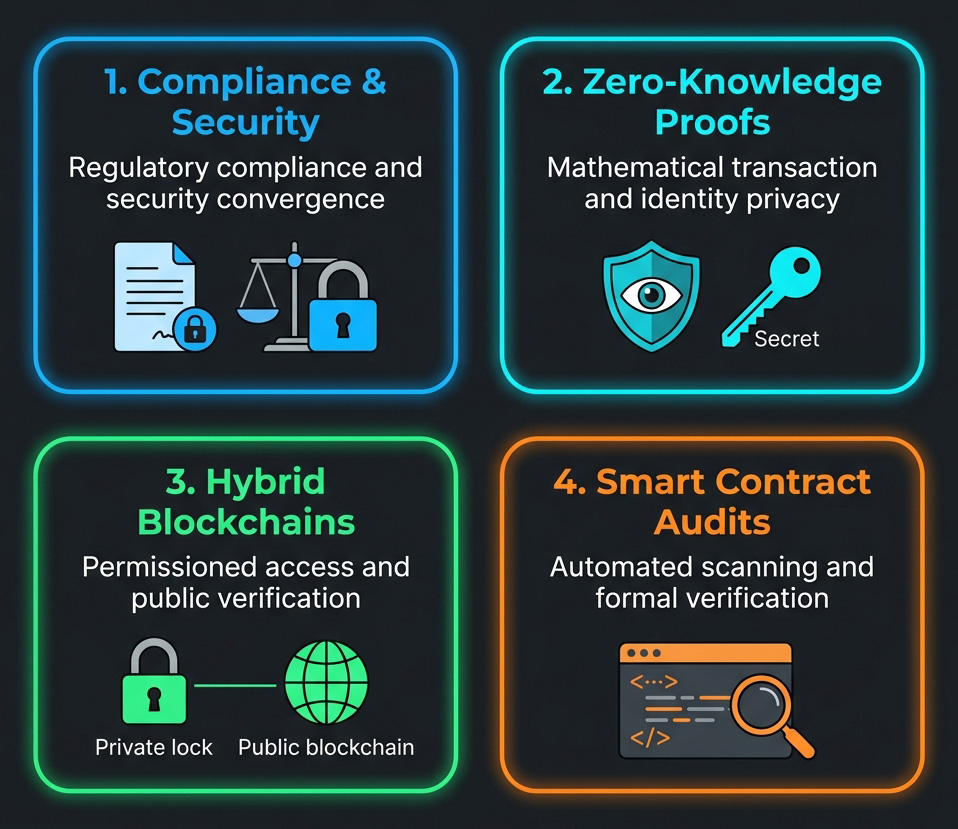
1. Regulatory Compliance and Security Are Converging
Governments across North America, Europe, and Asia are moving simultaneously on digital asset regulation, and the frameworks they are building, including AML requirements, data privacy mandates, and financial audit standards, effectively require higher baseline security from organizations operating in this space.
The marketing angle here is not to soften regulatory pressure, but to reframe it. Security as compliance readiness is a far stronger enterprise value proposition than security as risk avoidance. Buyers who are already under regulatory scrutiny are not asking whether they need to invest in security; they are asking which investment satisfies multiple requirements at once.
2. Zero-Knowledge Proofs Are Moving from Research into Production
Zero-knowledge proofs (ZKPs) allow one party to prove a statement is true to another party without revealing the underlying data. A practical analogy: proving you are over 21 without showing your birthdate, or your full ID for that matter. ZKPs apply the same logic to transactions, audits, and identity verification on-chain, allowing verification to happen without the exposure.
This matters for regulated industries like healthcare and financial services, where privacy is a legal requirement and not a preference. ZKPs are still rare in production deployments, which means being early to position around them signals genuine technical depth. Buyers in those verticals will reward that signal.
3. Permissioned and Hybrid Blockchains Are Winning Enterprise Deals
Most large enterprises do not want the full decentralization of public chains. They want to know who is on their network, who can validate transactions, and who is accountable when something goes wrong. Permissioned and hybrid blockchain architectures give them that, by combining private access controls with the cryptographic verification mechanisms of public chains. By mid-2025, 48 of the Fortune 100 were running at least one business-critical workload on permissioned or hybrid blockchain networks, which tells you where enterprise purchasing decisions are actually landing.
The trade-off is real: permissioned networks sacrifice some decentralization benefits, and acknowledging that trade-off in your messaging builds more trust than glossing over it. The buyer who understands what they are exchanging and why will close faster than the one who feels sold to.
4. Smart Contract Auditing Is Becoming Baseline Expectation
As DeFi protocols, tokenized assets, and on-chain governance structures scale, the pressure to formally verify smart contract code is intensifying from every direction, with institutional investors, enterprise procurement teams, and regulators all applying pressure simultaneously. Access control vulnerabilities alone accounted for $953 million in documented losses in 2024, which is the number that tends to end the "we'll audit it later" conversation in the room. Manual audits are giving way to automated scanning tools and formal verification methods that can mathematically prove a contract behaves as intended.
For brands operating in this space, the messaging opportunity is positioning as trust infrastructure: the layer that makes decentralized applications safe enough to build a business on. That framing speaks directly to the anxiety driving buying decisions right now.
The Five Pillars of Blockchain Security Messaging
After several years of marketing technically complex security products to audiences spanning CISOs, developers, compliance teams, and board members, I have found that the messaging strategies that consistently land share the same underlying structure. I call it the Five Pillars of Blockchain Security Messaging.
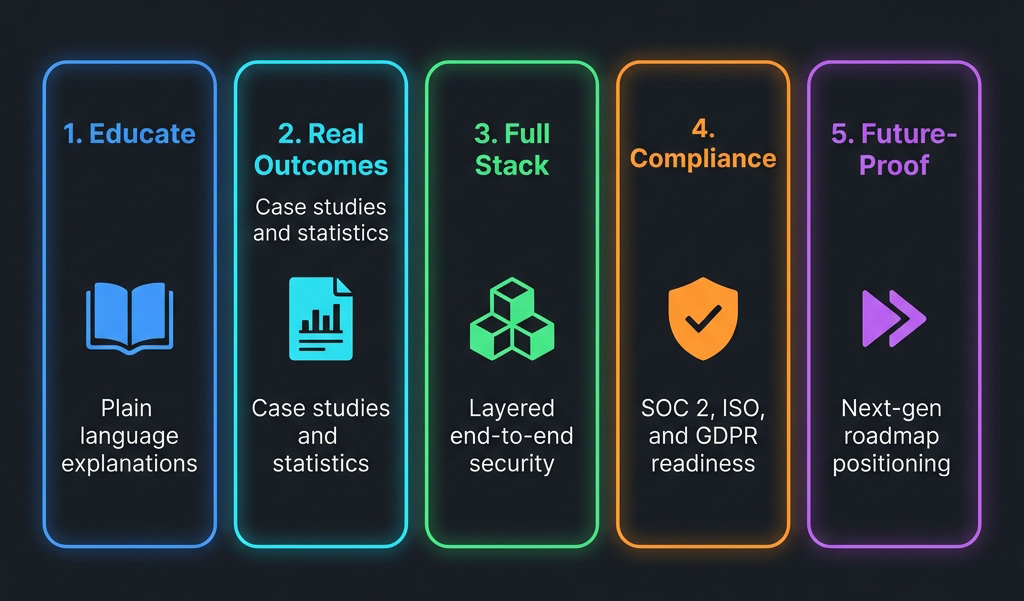
Pillar 1: Educate, Don't Intimidate
Fear-based messaging converts when a threat is immediate and the fix is simple. Blockchain security is neither. Audiences who feel overwhelmed by technical complexity do not buy faster; they stall. Content that explains attack vectors in plain language, traces them to real-world consequences, and then presents a clear path forward builds the kind of trust that shortens sales cycles more reliably than alarm bells.
Pillar 2: Anchor Claims in Real-World Outcomes
Case studies and specific incident examples outperform category claims in this space because the skepticism baseline is high. If your platform helped a DeFi exchange detect and prevent a reentrancy exploit, say so with the numbers that prove it. If you helped an enterprise deploy a compliant hybrid architecture, show the before-and-after. Specificity is the most efficient credibility mechanism available.
Pillar 3: Show the Full Stack
Sophisticated buyers know that attackers target the weakest link in a chain, and they have heard enough point-solution pitches to recognize one immediately. Messaging that walks through how you cover identity management, network security, contract auditing, and end-user education signals that you have thought about how breaches actually happen, not just what your product does in isolation.
Pillar 4: Lead with Compliance Readiness
SOC 2, ISO 27001, and GDPR alignment are not footnotes in enterprise deals; they are often the first questions in an RFP. Foregrounding your compliance architecture accelerates the buying process and gives procurement teams the language they need to build an internal case for your solution without coming back to you for clarification.
Pillar 5: Position for Where the Puck Is Going
Interoperability across chains, decentralized identity standards, and post-quantum cryptography are the conversations your most forward-thinking prospects are already having internally. Connecting your current capabilities to that roadmap positions your brand as a long-term infrastructure partner rather than a feature vendor solving today's problem.
Communicating Blockchain Security with Confidence
Blockchain security is maturing, and maturing categories reward the brands that learn to communicate with precision before the broader market catches up. The threats are real and will keep evolving. The technology countering them is genuinely impressive. And the audiences trying to make decisions across both are looking for someone who can speak fluently to the technical depth without losing the business context.
The marketers who get there first, who can walk into a room with a CISO, a compliance officer, and a product manager and leave each of them feeling like the conversation was built for them, are the ones who will shape this category for years ahead.
FAQ: Blockchain Security Messaging
What is blockchain security messaging?
Blockchain security messaging is the practice of communicating risks, protective mechanisms, and trust signals associated with blockchain-based systems in ways that drive confident purchasing decisions. It bridges the gap between deeply technical security architecture and the business-level concerns of buyers across compliance, operations, and finance.
What are the most common blockchain security threats in 2025?
The most operationally significant threats are smart contract exploits, phishing and social engineering attacks, and routing-level disruptions like DDoS. While 51% attacks receive substantial media attention, they require enormous resources to execute against established networks and pose a more realistic risk to smaller or newly launched chains.
What is a 51% attack on a blockchain?
A 51% attack occurs when a single actor or coordinated group gains majority control of a blockchain network's computational power or stake, enabling them to rewrite transaction history, double-spend assets, or block legitimate transactions from being confirmed. The attack's feasibility decreases as network size and hash rate increase.
What are zero-knowledge proofs and why do they matter for blockchain security?
Zero-knowledge proofs are cryptographic methods that allow one party to verify a claim to another party without revealing the underlying data that supports that claim. In blockchain security, they enable private and verifiable transactions, identity checks, and audit trails that satisfy regulatory requirements without exposing sensitive information to unauthorized parties.
What is the difference between a permissioned and a public blockchain?
A public blockchain allows any participant to join the network and validate transactions, while a permissioned blockchain restricts validation rights to an approved set of participants. Permissioned networks offer greater control over governance, data access, and regulatory compliance, but trade off some of the censorship-resistance properties that give fully public chains their security model.
How should marketers communicate blockchain security to non-technical audiences?
The most effective approach grounds security explanations in business outcomes rather than technical mechanisms: specifically, what is at stake if a system is compromised, what controls prevent that, and what confidence the buyer gains by choosing a particular solution.
Does decentralization make a blockchain fully secure?
Decentralization removes the single point of failure that makes centralized systems vulnerable to targeted attacks, but it does not eliminate risk from surrounding infrastructure. Smart contract bugs, compromised user credentials, and weak governance structures can all create exploitable vulnerabilities regardless of how decentralized the underlying network is.