In December 2023, the Federal Trade Commission (FTC) ordered Rite Aid to delete the customer photos its facial recognition system had wrongly matched to a shoplifting watchlist, along with every model and algorithm built from them. The system had been misidentifying shoppers, disproportionately women and people of color, for years before the order landed. Rite Aid is the clearest example yet of a legal remedy that reaches straight past a database and into the production AI system itself.
That order points to a technical capability called machine unlearning: removing a specific piece of data's influence from an already-trained model without retraining the whole system from scratch. Regulators, courts, and copyright plaintiffs now routinely demand exactly this, and whether your company can deliver it depends on architecture decisions your engineering team makes at training time, long before any request arrives.
What is machine unlearning, exactly?
Google Research, which ran the first public unlearning competition in 2023, frames the goal in one sentence: produce a model that behaves as though it never saw the data you want gone, without retraining the whole system from scratch to get there.
Here's the analogy I use with non-technical stakeholders. Say you bake a big batch of cookies, and afterward a customer tells you they're allergic to walnuts, which you already mixed into the dough. You have two options. Throw out the whole batch and start over, which costs time and money. Or figure out exactly which cookies have walnuts, pull just those out, and serve the rest. Machine unlearning is the second option, applied to model weights instead of a batch of cookies.
Why not just retrain from scratch every time? At real scale, that's neither quick nor cheap. GPT-3 reportedly cost around $4.3 million to train. GPT-4 cost an estimated $78 million. Google's Gemini Ultra ran past $190 million. No engineering org retrains a frontier model every time one person exercises a legal right to erasure, or every time someone discovers a licensing problem buried in the training set. Machine unlearning exists because "just retrain it" stopped being a real answer once frontier models got this expensive to build.
Why should engineering and leadership care about machine unlearning?
Machine unlearning has moved from research topic to compliance requirement, and the pressure is coming from three directions at once: privacy law, enforcement precedent, and copyright litigation. Each one turns a training pipeline decision into an executive risk.
The first is privacy law. Europe's General Data Protection Regulation (GDPR) grants people a right to erasure under Article 17, and regulators are increasingly asking whether that right reaches past the raw record and into any model trained on it. California's Consumer Privacy Act (CCPA), updated by the California Privacy Rights Act (CPRA), grants a similar right to delete, with violations running up to $7,500 per incident. Analysts have flagged the gap between "we deleted your row" and "we removed your influence on the model's weights," and closing that gap falls squarely on engineering. Legal can promise deletion. Your pipeline has to deliver it.
The second is enforcement precedent. The FTC has ordered outright model and algorithm destruction alongside data deletion in cases involving Cambridge Analytica, the photo app Everalbum, and Rite Aid. Legal analysts call this remedy algorithmic disgorgement: a company shouldn't get to keep profiting from a model built on data it collected unlawfully. If a pipeline ever ingests third-party data, scraped data, or data gathered under consent terms that later get challenged, the resulting model becomes a liability a regulator can order destroyed, engineering hours and compute spend included.
The third is copyright, with a technical twist worth knowing. The New York Times' lawsuit against OpenAI has spent much of 2026 fighting over what's inside OpenAI's training data and chat logs, with the Times accusing OpenAI of concealing its own ability to search that material. The central legal question turned out to be an engineering one: whether a system can search its own training corpus. The logging and provenance tooling your team builds today may end up as evidence in tomorrow's dispute.
How does machine unlearning actually work?
Machine unlearning splits into two broad families of technique: exact unlearning, which mathematically guarantees the target data is gone, and approximate unlearning, which uses targeted fine-tuning to get most of the way there for a fraction of the cost. Which one fits depends on your model's scale and how the data was structured going in.
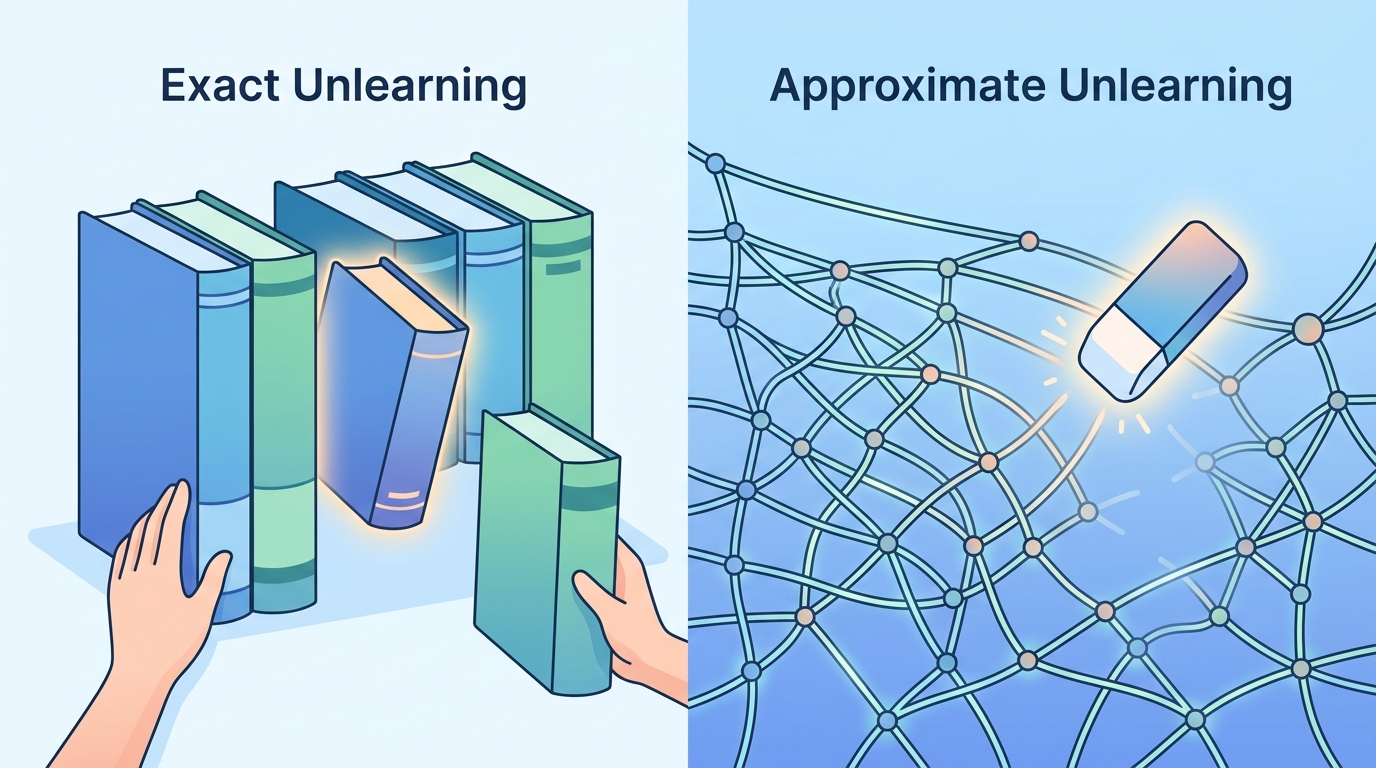
Exact unlearning gives you a mathematically clean answer: the resulting model is provably identical to one that never saw the deleted data. The best-known method, Sharded, Isolated, Sliced, and Aggregated (SISA) training, splits training data into independent shards at training time, trains a separate sub-model on each, and combines their outputs. A deletion request then only requires retraining the affected shard, cutting the cost roughly in proportion to the shard count. The shard boundaries have to be set before training starts, which is the whole design trade-off worth knowing now.
Approximate unlearning is what most teams reach for once a model gets large, since retraining even one shard of a frontier model can still be expensive. The most rigorous version applies differential privacy during training, a statistical guarantee that a model trained with or without a given example is indistinguishable, though it holds up best on smaller, tractable models and gets costlier as models scale. The more common production approach is a family of fine-tuning heuristics: gradient ascent on the data you want to forget, gradient descent on the data you want to keep, weight noise injection, and Kullback-Leibler (KL) divergence regularization to keep the rest of the model stable. Stanford's overview of the field is a good primer for getting your machine learning (ML) team and your legal team speaking the same language. None of this carries a formal guarantee, but combined it holds up to real scrutiny.
Either way, you need proof it worked. Google's 2023 competition and academic benchmarks like Task of Fictitious Unlearning (TOFU) and Weapons of Mass Destruction Proxy (WMDP) score unlearning on forgetting quality, model utility, and efficiency against a full retrain. Wire that evaluation into your release pipeline like any other model test, because "we unlearned it" without a way to verify it is not a claim you want to make to a regulator.
When do you actually need machine unlearning?
Machine unlearning applies whenever a specific piece of training data has to come out of a model without a full retrain, most often triggered by a privacy request, a regulatory order, a copyright dispute, a model acquisition, or a post-launch bias fix. Not every trigger calls for the same response. Here's how I map the most common ones to the right move.
How do you implement machine unlearning at your company?
Implementing machine unlearning comes down to two sets of decisions, one for engineering and one for leadership, and both need to happen before the first real request arrives.
On the engineering side, design for unlearning at training time. Decide up front what granularity you'll likely need deletions at, per customer, per data source, per content license, and shard accordingly, since that decision can't be retrofitted later. Pair it with a data provenance ledger: every training example tagged with its source, its consent or license basis, and a timestamp. It looks like overhead until someone asks you to prove a specific piece of data is gone, and then it's the difference between an afternoon and a forensic exercise. Wire the TOFU/WMDP-style evaluation into your release pipeline so "we unlearned it" comes with a test result behind it.
On the leadership side, fund this as infrastructure. Retrofitting unlearning onto a production model costs far more than designing for it up front, so budget for it before the first legal request lands. Treat vendor and foundation-model selection like a security review: ask providers in writing whether a deletion request reaches the model weights or only their database. Build a cross-functional governance process, legal, ML engineering, and data engineering with defined roles, and run it once as a tabletop exercise before a real request forces you to improvise. And be honest about whether your ML org has this expertise in-house; unlearning is becoming its own specialization, and the teams that build it early spend far less time firefighting later.
Nobody at Rite Aid decided one morning to misidentify shoppers. The harm came from architecture decisions made months earlier: what data to keep, for how long, and whether it could ever be removed. Machine unlearning is the technical foundation that decides whether the promises your company makes about data, privacy, and consent are ones your systems can actually keep.
If this connects to something you're trying to solve, book a complimentary consulting session. No pitch, just perspective.
Frequently asked questions about machine unlearning
What is machine unlearning in simple terms?Machine unlearning is the process of removing a specific piece of data's influence from an already-trained AI model without retraining the entire model from scratch. The result behaves as though it never saw the deleted data.
Is machine unlearning the same thing as deleting data from a database?Deleting a database record removes the raw data, but the patterns that record left behind in a model's weights can still remain. Machine unlearning targets those weights directly, which is why regulators increasingly treat data deletion and model deletion as separate obligations.
Why can't companies just retrain their AI models whenever data needs to be removed?At the scale of today's frontier models, retraining is prohibitively expensive: GPT-3 reportedly cost about $4.3 million to train, GPT-4 an estimated $78 million, and Google's Gemini Ultra more than $190 million. Machine unlearning exists to avoid paying that cost every time a deletion request arrives.
What laws or regulators push companies toward machine unlearning?The GDPR's Article 17 right to erasure and the CCPA/CPRA's right to delete both apply pressure, though neither explicitly names AI models. The clearest signal comes from FTC enforcement: the agency has ordered outright model and algorithm destruction alongside data deletion in cases against Cambridge Analytica, Everalbum, and Rite Aid.
What's the difference between exact and approximate machine unlearning?Exact unlearning, such as SISA (Sharded, Isolated, Sliced, and Aggregated) training, mathematically guarantees the resulting model is identical to one that never saw the deleted data, but it requires the shard structure to be built in at training time. Approximate unlearning uses techniques like gradient ascent and differential privacy to get close to that result on models where a full shard rebuild isn't practical.
How do you verify that machine unlearning actually worked?Through benchmarks purpose-built for the task, such as TOFU and WMDP, which score a model on forgetting quality, retained utility, and efficiency compared with a full retrain. Google's 2023 Machine Unlearning Challenge established the evaluation framework most of these benchmarks now build on.
When should a company start building machine unlearning into its AI systems?Before the first deletion request arrives. Sharding and data provenance decisions have to be made at training time, so retrofitting unlearning onto a model already in production costs far more than designing for it up front.